
Category: Podcast

  • Magna Est Veritas: From Persian Kings to Blameless Postmortems

    Magna Est Veritas: From Persian Kings to Blameless Postmortems

    When a multimillion‑dollar software system crashes, everyone wants the clean, binary answer you get from an X‑ray: broken or not broken, this is the exact fracture. In reality, the diagnostic “film” is clouded by human ego, terrified engineers, and executives demanding that someone—anyone—be fired immediately. This episode of The CAB Call, “Magna Est Veritas: From Persian Kings to Blameless Postmortems,” explores how to find truth when human nature is practically begging everyone to lie.

    Click here to display content from html5-player.libsyn.com.


    Episode overview

    The episode opens with a simple contrast: in medicine, a broken arm shows up as a jagged white line on an X‑ray, but in complex organizations, that line is smeared by politics, fear, and incentives. When a major system fails, the mechanical truth of what happened is difficult to expose precisely because the people closest to it are terrified of the consequences.

    To understand how truth can ever prevail in that environment, you walk listeners through a layered stack of sources. You start with the apocryphal book of 1 Esdras in the Persian Empire, then examine how the Masonic Order of the Red Cross codified those ideas into ritual, and finally map them directly onto modern practices like SSOT architectures and blameless postmortems. The through‑line is consistent: truth is great, and it will prevail—if we are willing to submit our egos to it.


    Truth in the court of King Darius

    The first major section dives into 1 Esdras 3–4, set during the reign of Darius in the Persian Empire. Jerusalem lies in ruins, the Jewish people are trying to rebuild their temple, and political progress is stalled when the story zooms into the king’s court for the “immemorial discussion.” Three royal guards decide to hold a high‑stakes rhetorical contest: each writes down a single sentence on what is the strongest force in the world, and slips it under the king’s pillow, wagering massive honor and wealth on the outcome.

    The first guard argues for wine as the strongest force, not because of its flavor, but because it “leaves astray the minds of all who drink it.” Wine becomes the great eraser of reality, dissolving debts, sorrows, and even allegiances, equalizing king and slave in chemically induced forgetfulness. The second guard plays to the room by arguing for the king’s power, pointing at Darius himself as the embodiment of terrifying temporal authority: command to march, and armies march; command to build or destroy, and labor and spoils flow without question.

    The third guard, Zorobabel, answers in two stages. First, he pivots to women and emotion, pointing out that men will abandon parents, betray countries, and surrender wealth just to cleave to a woman—and even the great Darius bends under a concubine’s influence. Then he makes his real move: he argues for the sovereignty of truth, declaring that “truth is great and stronger than all things… it prevails forever and ever.” Wine is wicked, kings are wicked, and human passions are wicked in the sense that they are subject to decay and error, but truth is impartial, incorruptible, and unmoved by bribes, swords, or emotional attachments.


    “Magna est veritas” as an operating system

    The court erupts at this argument, shouting “Magna est veritas, et praevalebit”—great is truth, and it will prevail—as Darius grants Zorobabel’s request to return the holy vessels and rebuild the temple. The key mechanism is not that truth is nicer or more comforting; it is that bridges fall, empires rise and collapse, and systems fail regardless of what anyone believes about them. A collapsed bridge is a collapsed bridge whether the king approves or not, and the same is true of a corrupted database or broken failover plan.

    You translate this directly into a modern boardroom. Contemporary companies still worship the same three “false idols” described in the story: wine becomes the intoxicating hype cycle of stock price and corporate perks, kings become CEO mandate and executive ego, and women/emotion become marketing, branding, and consumer manipulation. Into that room walks the modern Zorobabel—the SRE, lead systems engineer, or data scientist—who insists that the only thing keeping the enterprise from burning down is the raw, objective truth of the system’s data and telemetry.


    The Masonic Order of the Red Cross as “narrative technology”

    The episode then uses the Illustrious Order of the Red Cross in the York Rite of Freemasonry as a historical “translation layer” that preserves this philosophy of truth. Thomas Smith Webb’s 1797 Freemasons’ Monitor is presented as a kind of organizational architecture that took scattered legends and degrees and assembled them into a coherent “narrative technology.” The Red Cross solves a structural problem in the Masonic journey: how to bridge an Old Testament, temple‑focused narrative into a Christian chivalric order without breaking immersion.

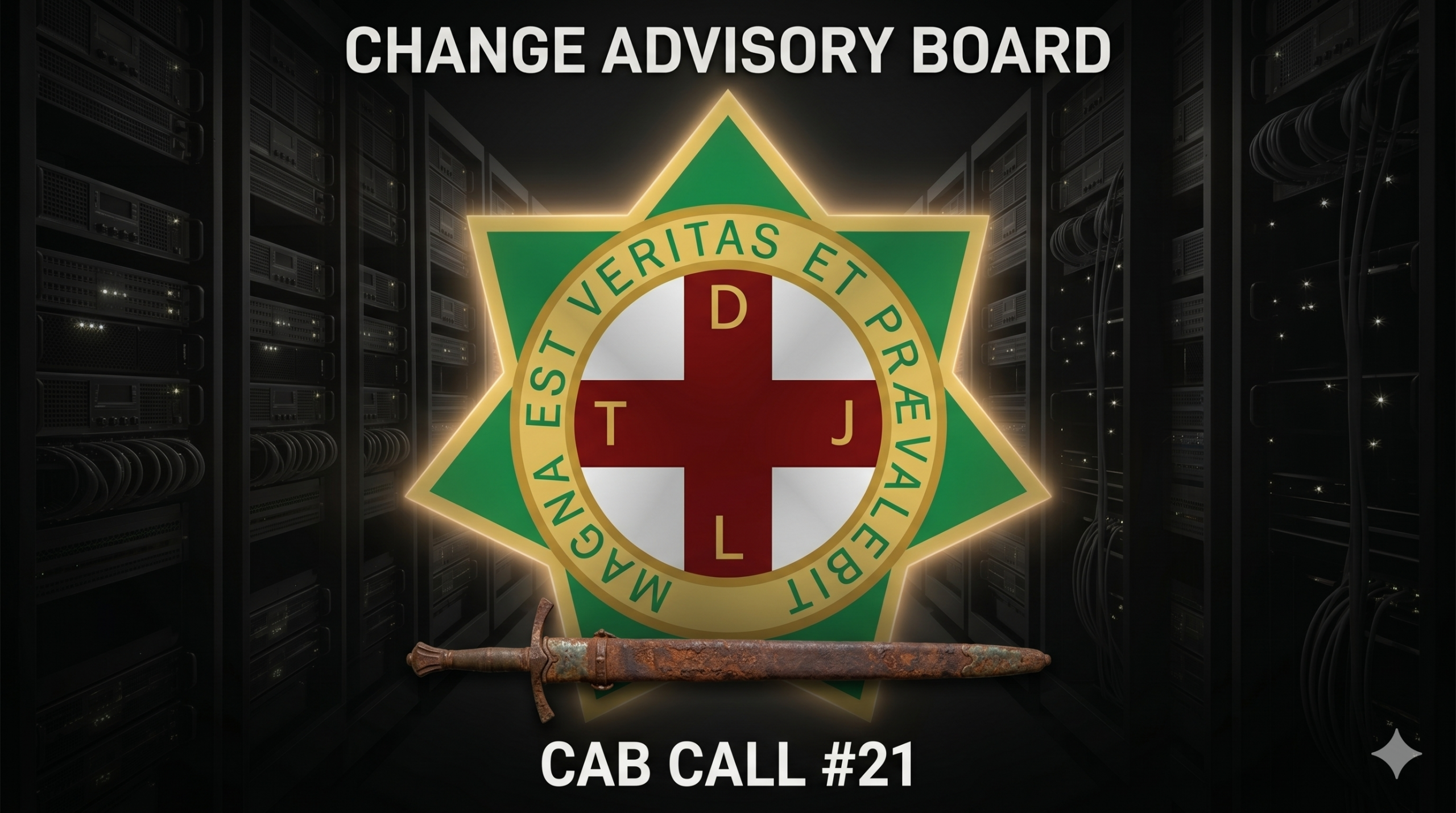
    The bridge is built using truth as a universal data format. In the ritual, the candidate effectively re‑enacts Zorobabel’s journey to the Persian court, with the Order of the Red Cross acting as a psychological API between the “operating system” of the Old Testament and the “operating system” of the New Testament. Symbols are standardized in the 1892 Denver revision: the green banner of hope with a seven‑pointed star bearing “Magna est veritas et praevalebit,” and the red jewel cross inscribed with D‑T‑J‑L—Deity, Truth, Justice, Liberty.

    Those four letters are treated as the system’s core operating principles. Deity signifies recognition of an ultimate God of truth; Truth is the sovereign, impartial reality; Justice is truth applied to human affairs; and Liberty is the freedom that results when truth and justice function properly. The ritual even includes a physical bridge engraved with “LDP LDP” (Libertas Passe, liberty of passage), interpreted by Albert Pike as liberty of thought, speech, and action granted by objective knowledge.


    The sword, DTJL, and psychological impartiality

    The most striking piece is the sword given to Zorobabel for his journey across the bridge. The ritual is explicit that this sword is not a weapon of aggression, but an instrument solely to defend truth, with a vow that it must never be drawn in the cause of injustice, falsehood, or oppression. Candidates are instructed to let the sword rust in its scabbard rather than draw it even once in the defense of a lie. This is framed not just as a pledge to “be good,” but as a vow of extreme impartiality: protect objective truth even if it costs your position, your comfort, or your safety.

    You connect this directly to organizational resilience. If leaders use their “sword”—administrative power, voice, and influence—to attack subordinates in order to protect their own reputation, they violate the very architecture of resilience the ritual encodes. The Masonic sources argue that, because truth is divine and impartial, human systems that want to survive must attempt the same impartiality: no punishing people for bad news, no incentives to hide the truth, and no rewarding of spin over telemetry. That becomes the baseline psychological standard by which you evaluate modern tech and corporate practices.


    Single Source of Truth (SSOT) as a modern “temple”

    From there, the episode shifts into contemporary primary sources on Single Source of Truth (SSOT) design. The KPI Fire documentation you reference defines SSOT not as a specific database product, but as a state of being for company data: centralized, consistent, accessible, and scalable. Multiple versions of the truth scattered across dashboards and spreadsheets are described as catastrophic, leading to paralysis, contradictory narratives, and politically driven decision‑making.

    You illustrate this with a concrete scenario: marketing’s dashboard says 10 million in revenue, engineering’s system shows 8–9 million in server spend, and the C‑suite’s spreadsheet says everything is highly profitable. Each group is living in a different reality, and the loudest executive wins rather than the person with the most accurate data. The SSOT exists to force every ego in the building to bow to the same objective facts, just as the rebuilt temple and its vessels gave the Jewish community a central, unified focus in the ancient narrative.


    Blameless postmortems as ritualized truth‑seeking

    The next layer is SRE and blameless postmortems. You walk through a modern failure scenario: a large cloud platform goes down, dollars vaporize by the minute, and the primal instinct is to find who typed the wrong command and fire them on the spot. SRE literature argues that if you want a true SSOT after an incident, engineers must feel psychologically safe enough to tell the unvarnished story of what happened. Fear triggers fight‑or‑flight responses, and frightened humans lie or omit details to survive.

    A well‑run blameless postmortem is portrayed as a ritual with its own strict rules. The process bans “who” and “why” questions, which attack character and trigger defensiveness, and instead insists on “how” and “what”: how the system failed, what processes were missing, what signals were visible at each step. Pronouns are policed: “we missed a step” replaces “you didn’t check,” turning the meeting from a hunt for a culprit into a collaborative reconstruction of reality. You explicitly frame this as a modern execution of the Red Cross vow: the engineers are sheathing their swords of blame so that the objective timeline can be preserved.


    Scapegoats, false accountability, and Agatha Christie endings

    The final tier of sources is opinion writing on false accountability and the scapegoat mechanism. These pieces argue that public culture often equates accountability with visible punishment—prison sentences, public firings, and spectacle—while allowing structural rot to continue unexamined. Drawing on René Girard’s mimetic theory, you describe how communities in crisis unconsciously collude to load systemic sins onto a single victim and expel them to release tension.

    An analogy from Guido Vilo likens this to an Agatha Christie novel: the village is anxious after a crime, everyone is a suspect, and peace is restored only when a brilliant detective reveals a single murderer who is led away in handcuffs. Real complex systems do not behave that way—failures are emergent results of many interacting factors—but organizations still crave that narrative simplicity. When leaders treat incidents like murder mysteries, they may feel emotionally satisfied, but they guarantee that logs will be altered, evidence will vanish, and the system will fail again.


    Closing challenge: is your system ruled by truth or fear?

    The episode closes by pulling all layers together: 1 Esdras shows truth outlasting wine, kings, and emotion; the Order of the Red Cross codifies that insight into DTJL and a vow to keep the sword sheathed; SSOT architectures and blameless postmortems build literal and cultural temples to the same idea in the digital age. Opposing all of this is the deeply ingrained scapegoat impulse and a false culture of accountability that treats punishment as a substitute for understanding.

    You end by asking listeners to examine their own organizations, families, and relationships. If truth truly is the almighty force that outlasts empires, what “logs” are they hiding because they treat people around them like punitive King Darius instead of allies in the search for reality? A culture of punishment builds fragile, doomed systems; a culture of truth builds resilient ones.

    Sources


  • The Trestleboard vs. Reality: The Anatomy of Tech Executive Failures

    The Trestleboard vs. Reality: The Anatomy of Tech Executive Failures

    Dissecting Tech Executive Failures

    Click here to display content from html5-player.libsyn.com.

    In this episode, we open the dossiers on some of the biggest names in tech—Amazon, Tesla, Intel, Salesforce, IBM, and Microsoft—to perform a ‘professional opposition research’ exercise into the root causes of tech executive failures. We move past the hype of visionary keynotes and earnings calls to reveal that what we often mistake for financial forecasting is actually pure narrative engineering.

    Using a unique architectural framework rooted in masonic metaphors, we dissect the ‘Divergence of Executive Intent’ in tech financial forecasting through four structural components:

    * The Plum: The executive’s bold, initial strategic forecast.
    * The Level: The cold, hard empirical data of SEC filings and product delivery.
    * The Trowel: The rhetorical mortar used to smooth over the cracks when the “Plum” misses the “Level”.
    * The Ashler: The perpetually promised, perfected future state that is always “three to five years away”.

    From Arvin Krishna’s ‘revenue illusions’ and the structural meltdown of the IBM Kyndryl spinoff, to Brad Smith’s use of ‘philanthropic halos’ to mask technological failures at Microsoft, we explore how accountability is routinely deferred. We also analyze the ‘Watson Hangover’ and how it forced a rebranding of IBM’s AI strategy into the more pragmatic Watsonx.

    Join us as we discuss why Wall Street rewards this “narrative distortion field” and how you can learn to ruthlessly separate the math from the narrative.

    Link to Sources

  • The Secret Master

    The Secret Master

    Click here to display content from html5-player.libsyn.com.

    Secret Masters & Site Reliability: Scottish Rite Freemasonry Meets SRE, Cybersecurity, and the Ethics of AI

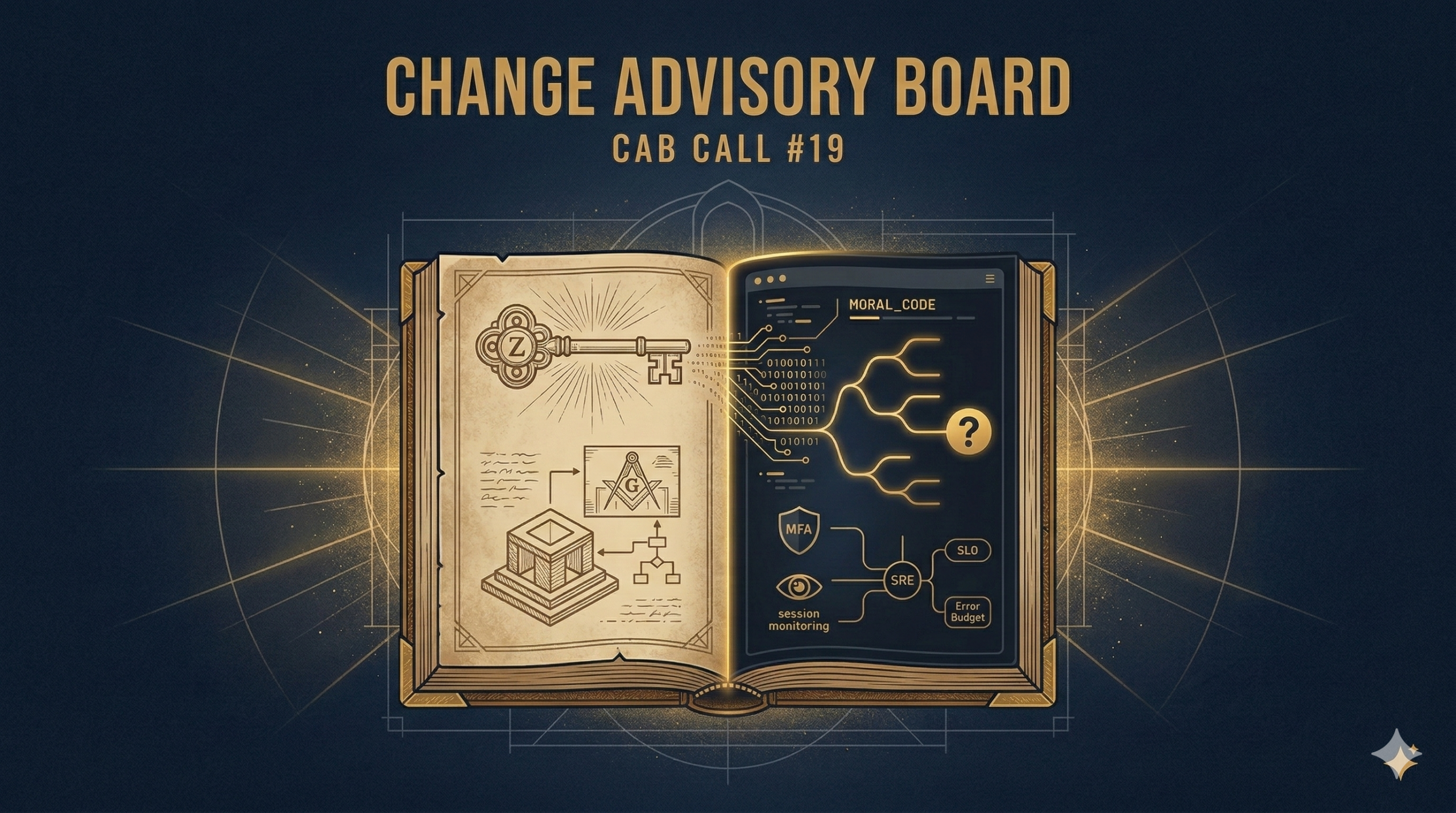
    This episode of The CAB Call explores parallels between Scottish Rite Freemasonry—especially the 4th degree Secret Master—and modern site reliability engineering and cybersecurity. Using sources like Pike’s Morals and Dogma, Clawson’s Commentaries, SRE (O’Reilly), guidance on privileged user responsibilities, and Phil Rogaway’s arguments about cryptography, it frames the Scottish Rite as an “expansion pack” dependent on the Blue Lodge foundation, where loss of Blue Lodge standing ends Scottish Rite membership. It compares Masonic study aids such as A Bridge to Light and the Ritual Monitoring Guide to SRE runbooks, emphasizing critical thinking over rigid dogma. The discussion maps SRE error budgets, CI/CD iteration, observability, least privilege, MFA, session monitoring, and blameless postmortems onto Masonic ideals of duty, secrecy, human fallibility, and pursuit of light, ending with questions about what moral code will be embedded into autonomous AI systems.

    00:00 Welcome and Premise

    01:20 Sources and Core Question

    02:42 Blue Lodge Base Layer

    05:31 Cognitive Load and Runbooks

    08:29 Critical Thinking Over Dogma

    10:04 Error Budgets and Fallibility

    13:26 Continuous Improvement and Rebuilds

    15:18 Secrecy Versus Observability

    20:35 Incident Response and Duty

    24:16 AI and Cyber Civility

    25:56 Summary and Final Questions

    Sources

  • Order of the Eastern Star

    Order of the Eastern Star

    Click here to display content from html5-player.libsyn.com.

    What does a 19th-century fraternal organization have to teach us about modern corporate governance and female empowerment?

    In this episode of The CAB Call, we’re looking at a secret hiding right in plain sight: the Order of the Eastern Star. Far from the dark associations of its inverted star emblem, it is actually the largest fraternal organization in the world where both men and women can belong.

    We break down how this appendant body survived a failed startup phase to become a massive global network—and a fascinating case study in history, theology, and organizational design.

    The Origins: How Dr. Rob Morris (the visionary) and Robert McCoy (the operator) designed “adoptive masonry”. They created a way to extend the protective umbrella of the lodge to families, without violating the strict rules that prohibited women from being made Masons.

    The Symbols: We decode the five-pointed star, the often-misunderstood F.A.T.A.L. acronym, and the intense biographies of the five biblical heroines they represent: Adah, Ruth, Esther, Martha, and Electa.

    The Governance: How the leadership split between the Worthy Matron (acting as CEO) and the Worthy Patron (acting as Chief Compliance Officer) mirrors modern corporate boards. We explore how this ingenious structure allowed women to run the business while relying on a Master Mason to ensure constitutional legitimacy.

    The Legacy: From providing a vital support network on the frontier for Laura Ingalls Wilder, to functioning as a parliamentary leadership academy for civil rights icons like Rosa Parks.

    Join us as we explore whether the matron-and-patron model isn’t just a relic of the past, but a highly effective blueprint for separating governance from execution.

    Below is an AI-generated infographic depicting the organization structure of OES.

    Sources

  • The Mason and The Mainframe

    The Mason and The Mainframe

    Click here to display content from html5-player.libsyn.com.

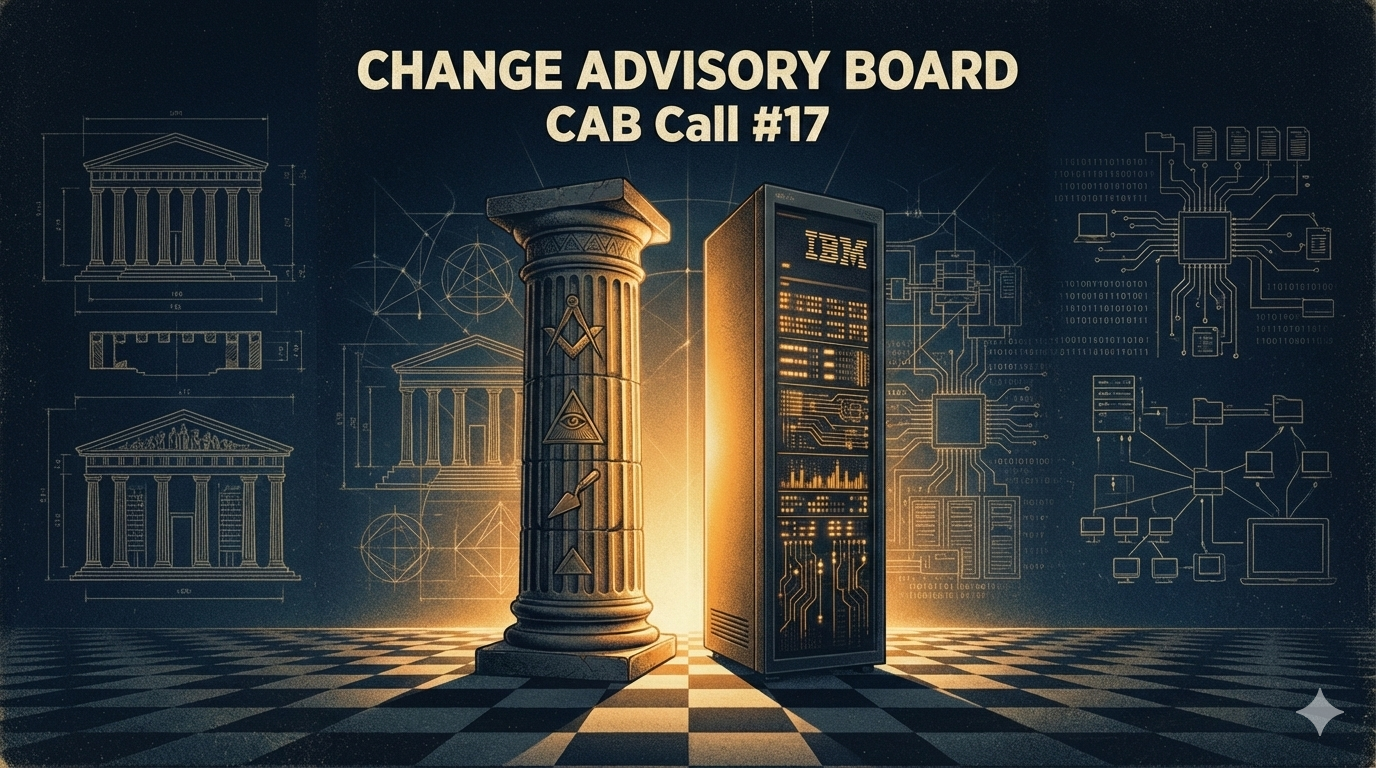
    What do the IBM Z Mainframe and Ancient Freemasonry have in common? They are both obsessed with one thing: Endurance.

    In this episode of The Cab Call, we attempt a seemingly absurd comparison between the digital world and the social world. We pit the “Mainframe Advocate” against the “Masonry Advocate” to debate the concept of State Preservation.

    One runs on silicon, electricity, and error-correcting code. The other runs on ritual, memory, and oral tradition. Both are trying to achieve the exact same goal: keeping a specific set of data intact while the world around them changes.

    The Challenge: Which is harder? Preserving a banking ledger with zero corruption for 60 years, or preserving a spoken ritual word-for-word for six centuries?

    Transmission: How Mainframe modernization (CDC, Refactoring) compares to Masonic “Word Pairs” and the “Attentive Ear.”

    Resilience: Disaster recovery (GDPS, Metro Mirror) vs. the distributed network of human memory.

    The Crisis: How both systems face an identical existential threat—the skills gap and the need for apprenticeship.

    Join us as we decide whether it’s harder to preserve a binary digit or a moral truth.

    Sources

  • Murder and Treason Excepted

    Murder and Treason Excepted

    Click here to display content from html5-player.libsyn.com.

    In this episode, we wrestle with one of the most agonizing ethical dilemmas in history: What happens when institutional loyalty violently clashes with personal moral duty?

    We begin by dissecting the terrifying “exception clause” found in ancient fraternal oaths: Murder and Treason Excepted. We explore the “Cable Tow”—the symbolic rope binding members together—and ask what happens when that rope becomes a noose for the truth.

    Drawing on a compelling set of sources, we trace the dark history of weaponized loyalty, from the infamous Morgan Affair of the 1820s to the subversive corruption of the P2 Lodge in Italy. We then pivot to the modern day, applying these lessons to the concept of “Moral Injury” in law enforcement and the heartbreaking institutional failures in Uvalde, Texas. Why do communities “circle the wagons” in the face of tragedy? We explain the psychology of “Identity Protective Cognition” and the concept of “Untempered Mortar”—the silence that causes structures to collapse.

    Sources: https://notebooklm.google.com/notebook/0e615a06-8fcb-4b09-bf5b-95eb1a1fa21a

  • The Square and The Sphere

    The Square and The Sphere

    Click here to display content from html5-player.libsyn.com.

    China’s expanding presence across Africa is often described in terms of infrastructure, resource extraction, security agreements, and spheres of influence. In this episode of The Change Advisory Board, we examine the China–Africa relationship through a different lens—one rooted not in economics or diplomacy, but in an older moral operating system.

    Using the Masonic working tools of the Square, Level, and Plumb, this episode treats modern statecraft as a system under ethical stress. Rather than asking whether China’s engagement in Africa is “good” or “bad,” we ask a more difficult question: can moral integrity survive inside a sphere of influence at all?

    We trace the historical presence of Freemasonry in both China and Africa to establish the ethical framework, then analyze China’s four strategic pillars on the continent—political leverage, resource security, security guarantees, and ideological projection. These ambitions are tested against real-world instability, including events in the Great Lakes region and the collapse of externally brokered peace efforts in the Democratic Republic of Congo.

    Throughout the episode, we distinguish necessity from virtue, examining where partnerships appear to meet on the level—and where overwhelming material interests bend the plumb and unbalance the square. The result is not a partisan judgment, but a sober diagnosis of the structural limits of moral perfection in nation-state behavior.

    This episode is for listeners interested in ethics, systems thinking, and the tension between moral ideals and geopolitical power.

    Sources

  • Engineering Principles Are Moral Blueprints

    Engineering Principles Are Moral Blueprints

    Click here to display content from html5-player.libsyn.com.

    This episode of Change Advisory Board is a deep dive for mechanics, technicians, and engineers who live every day inside load tables, torque specs, tolerances, and fluid systems—but may not have considered that these technical disciplines are also moral ones.

    We explore how the core principles of engineering mechanics—statics, dynamics, geometry, material science, and energy management—form a direct parallel to the ancient moral architecture preserved in Freemasonry. Concepts like moment of inertia, section modulus, lever equilibrium, fastener preload, tolerance classes, hydraulic pressure, thermal regulation, and metallurgical tempering are examined not only as physical necessities, but as ethical blueprints for building a stable life and character.

    Using real mechanical examples—from beam geometry and bolt stretch to Pascal’s Principle, cooling system failures, and heat-treated steel—we show how wisdom, strength, and beauty are not abstractions, but operational requirements. Wisdom is foresight and calculation. Strength is material integrity and disciplined execution. Beauty is harmony: the efficient, resilient system that performs as intended without waste or collapse.

    The episode bridges operative masonry and speculative philosophy, tracing how geometry has always been treated as a sacred language of creation—from ancient China and Egypt, through cathedral builders and Enlightenment thinkers, to the modern shop floor. The tools of the craft—the gavel, square, plumb, and compasses—are revealed as precision instruments for both machines and men.

    For technicians who take pride in doing things right, this episode argues that your daily work is already a moral practice. When performed with accuracy, restraint, and respect for immutable laws, engineering is not just labor—it is a lived philosophy.

    Sources

  • The Gavel, the Gauge, and the Broken Foundation

    The Gavel, the Gauge, and the Broken Foundation

    Click here to display content from html5-player.libsyn.com.

    This episode confronts one of the most difficult crises a person can face: the collapse of life under addiction—and the parallel responsibility of a fraternity committed to lifting a worthy brother in distress. Through a dual lens of Alcoholics Anonymous and Freemasonry, we explore addiction not as a moral failure but as a physical abnormality paired with a devastating mental distortion: the loss of perspective that allows a person to take the first drink despite knowing the consequences.

    We trace the progression from physical compulsion to shattered resolve, isolation, self-deception, and the spiritual walls that keep so many trapped. Then we walk through the architecture of recovery: surrender, moral inventory, confession, character repair, and sustained service. Each phase of the Twelve Steps is examined as a disciplined reconstruction of a man’s inner foundation.

    From there, we map these principles directly onto the Craft’s moral blueprint. The common gavel becomes the tool of inventory. The 24-inch gauge becomes the mandate for service. The Lewis symbolizes the fraternity’s duty to bear the burden of a fallen brother. The immovable jewels provide the moral geometry for rebuilding a life upright.

    The result is a unified framework: the spiritual labor of recovery reinforced by the symbolic architecture of Freemasonry. Both insist that the highest attainment comes through humility, self-examination, and service. And both reveal that profound suffering, when met with discipline and fellowship, can become the accelerated path toward becoming a true operative builder.

    Source #01: Alcoholics Anonymous 4th Edition

    Source #02: The Builders. A Story and Study of Masonry by Joseph Fort Newton, Litt. D. 

    Source #03: The Lecture of the First Degree of Freemasonry

    Source #04: Entered Apprentice Lecture by phoenixmasonry.org

    Source #05: The Lecture of the Second Degree of Freemasonry

  • Stone, Soul, and Software

    Stone, Soul, and Software

    Click here to display content from html5-player.libsyn.com.

    The philosophical principles underlying human conduct and ancient wisdom traditions establish a framework for understanding order and morality. Marcus Aurelius emphasized that the body is perishable, merely a “little flesh and breath” or a “network, a contexture of nerves, veins, and arteries”, while the rational soul should seek to know itself and choose its own nature. The end for rational animals is to follow reason, be content with destiny, and understand that the Universe is transformation. This pursuit of wisdom is paralleled in Freemasonry, which holds that all elevating and benign religions share fundamental truths. Masonry, founded on Geometry, or the fifth science, utilizes symbols like the Rough Ashlar, representing the unpolished mind awaiting cultivation through liberal education, and the pillars Boaz and Jachin, which denote strength and stability.

    Ancient texts, particularly the King James Version (KJV) of the Bible, have shaped modern language and literature. The KJV has contributed more to English than perhaps any other literary source, providing phrases like “The spirit indeed is willing, but the flesh is weak” (Matthew 26:41) and introducing words like helpmate, derived from “help meet for him” in Genesis. Its influence is evident across English literature in works by Shakespeare, John Milton (Paradise Lost), Herman Melville (Moby-Dick), and C.S. Lewis. The original KJV included the Old Testament, New Testament, and the Apocrypha, though the Apocrypha was later removed in the 1800s by scholars concerned about contradictions and whether the books were divinely inspired. The KJV is textually connected to the Textus Receptus, and resources like the King James Bible Dictionary exist to clarify its content, covering topics such as Strong’s Numbers.

    In modern technology, Site Reliability Engineering (SRE) embodies a structured approach to maintaining complex systems, focusing on reliability as the “most fundamental feature of any product”. SRE, which originated from asking a software engineer to design an operations team, caps operational work (toil)—defined as manual, repetitive work that scales linearly—at 50% of an engineer’s time to ensure focus on engineering projects. Core SRE principles include managing service risk using error budgets, employing automation to maximize consistency and reduce costs, and utilizing distributed consensus algorithms like Paxos and Chubby to manage critical state reliably across failures. Monitoring is essential, prioritizing actionable alerts (immediate human intervention) and classifying outputs clearly (Alerts, Tickets, Logging). These practices, particularly preparedness, postmortem analysis, and automation, align with fundamental lessons learned across other high-reliability industries, such as the nuclear navy, defense, and aviation.

    Source #01: Site Reliability Engineering edited by Betsy Beyer, Chris Jones, Jennifer Petoff, and Niall Richard Murphy

    Source #02: Contribution of the King James Bible to the English Language – International Journal of Applied Research