Tag: Freemasonry

  • Order of the Eastern Star

    Order of the Eastern Star

    What does a 19th-century fraternal organization have to teach us about modern corporate governance and female empowerment?

    In this episode of The CAB Call, we’re looking at a secret hiding right in plain sight: the Order of the Eastern Star. Far from the dark associations of its inverted star emblem, it is actually the largest fraternal organization in the world where both men and women can belong.

    We break down how this appendant body survived a failed startup phase to become a massive global network—and a fascinating case study in history, theology, and organizational design.

    The Origins: How Dr. Rob Morris (the visionary) and Robert McCoy (the operator) designed “adoptive masonry”. They created a way to extend the protective umbrella of the lodge to families, without violating the strict rules that prohibited women from being made Masons.

    The Symbols: We decode the five-pointed star, the often-misunderstood F.A.T.A.L. acronym, and the intense biographies of the five biblical heroines they represent: Adah, Ruth, Esther, Martha, and Electa.

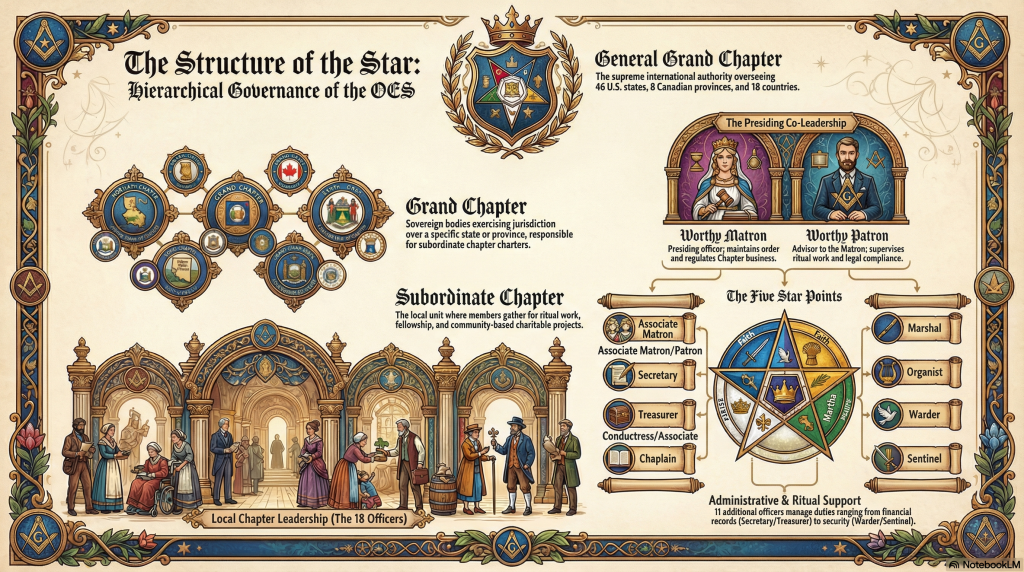
    The Governance: How the leadership split between the Worthy Matron (acting as CEO) and the Worthy Patron (acting as Chief Compliance Officer) mirrors modern corporate boards. We explore how this ingenious structure allowed women to run the business while relying on a Master Mason to ensure constitutional legitimacy.

    The Legacy: From providing a vital support network on the frontier for Laura Ingalls Wilder, to functioning as a parliamentary leadership academy for civil rights icons like Rosa Parks.

    Join us as we explore whether the matron-and-patron model isn’t just a relic of the past, but a highly effective blueprint for separating governance from execution.

    Below is an AI-generated infographic depicting the organization structure of OES.
    Sources

  • The Mason and The Mainframe

    The Mason and The Mainframe

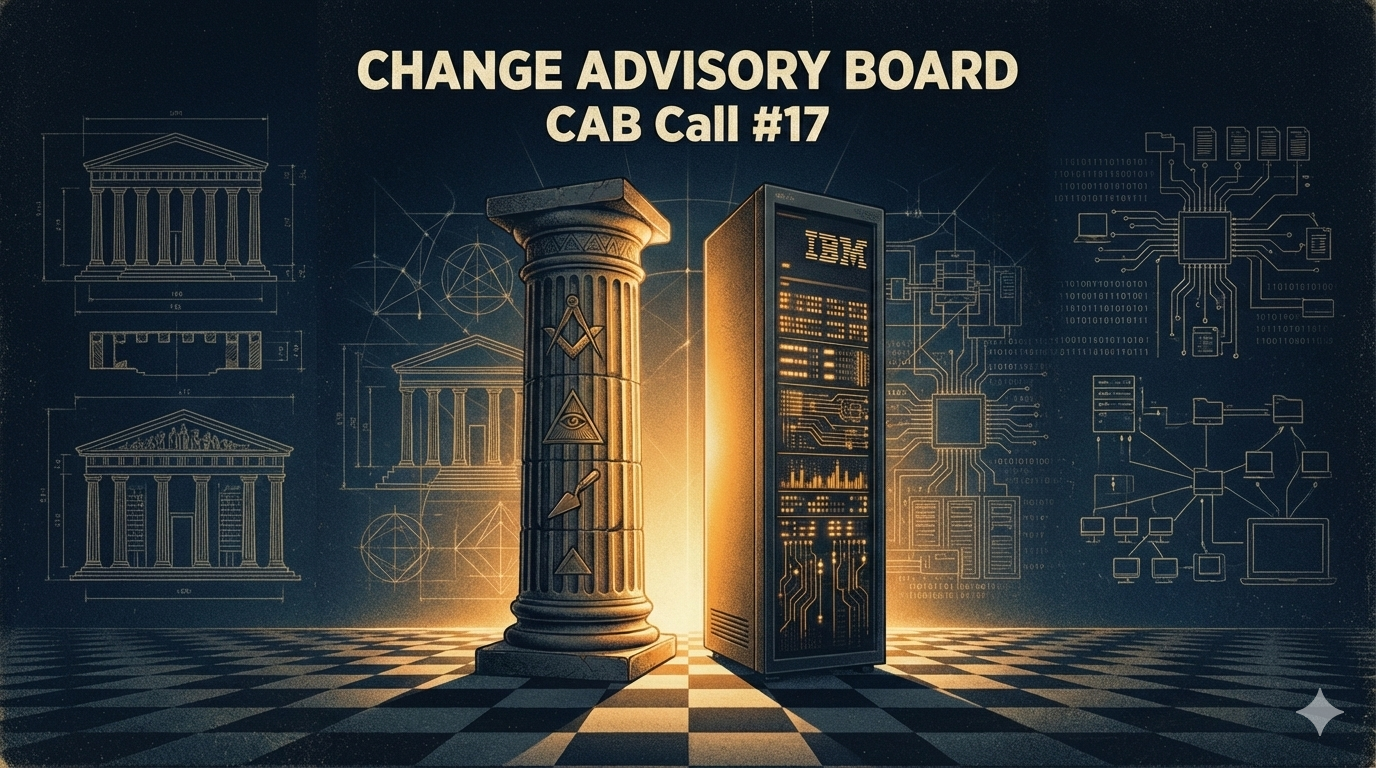
    What do the IBM Z Mainframe and Ancient Freemasonry have in common? They are both obsessed with one thing: Endurance.

    In this episode of The Cab Call, we attempt a seemingly absurd comparison between the digital world and the social world. We pit the “Mainframe Advocate” against the “Masonry Advocate” to debate the concept of State Preservation.

    One runs on silicon, electricity, and error-correcting code. The other runs on ritual, memory, and oral tradition. Both are trying to achieve the exact same goal: keeping a specific set of data intact while the world around them changes.

    The Challenge: Which is harder? Preserving a banking ledger with zero corruption for 60 years, or preserving a spoken ritual word-for-word for six centuries?

    Transmission: How Mainframe modernization (CDC, Refactoring) compares to Masonic “Word Pairs” and the “Attentive Ear.”

    Resilience: Disaster recovery (GDPS, Metro Mirror) vs. the distributed network of human memory.

    The Crisis: How both systems face an identical existential threat—the skills gap and the need for apprenticeship.

    Join us as we decide whether it’s harder to preserve a binary digit or a moral truth.

    Sources

  • Murder and Treason Excepted

    Murder and Treason Excepted

    In this episode, we wrestle with one of the most agonizing ethical dilemmas in history: What happens when institutional loyalty violently clashes with personal moral duty?

    We begin by dissecting the terrifying “exception clause” found in ancient fraternal oaths: Murder and Treason Excepted. We explore the “Cable Tow”—the symbolic rope binding members together—and ask what happens when that rope becomes a noose for the truth.

    Drawing on a compelling set of sources, we trace the dark history of weaponized loyalty, from the infamous Morgan Affair of the 1820s to the subversive corruption of the P2 Lodge in Italy. We then pivot to the modern day, applying these lessons to the concept of “Moral Injury” in law enforcement and the heartbreaking institutional failures in Uvalde, Texas. Why do communities “circle the wagons” in the face of tragedy? We explain the psychology of “Identity Protective Cognition” and the concept of “Untempered Mortar”—the silence that causes structures to collapse.

    Sources: https://notebooklm.google.com/notebook/0e615a06-8fcb-4b09-bf5b-95eb1a1fa21a

  • The Square and The Sphere

    The Square and The Sphere

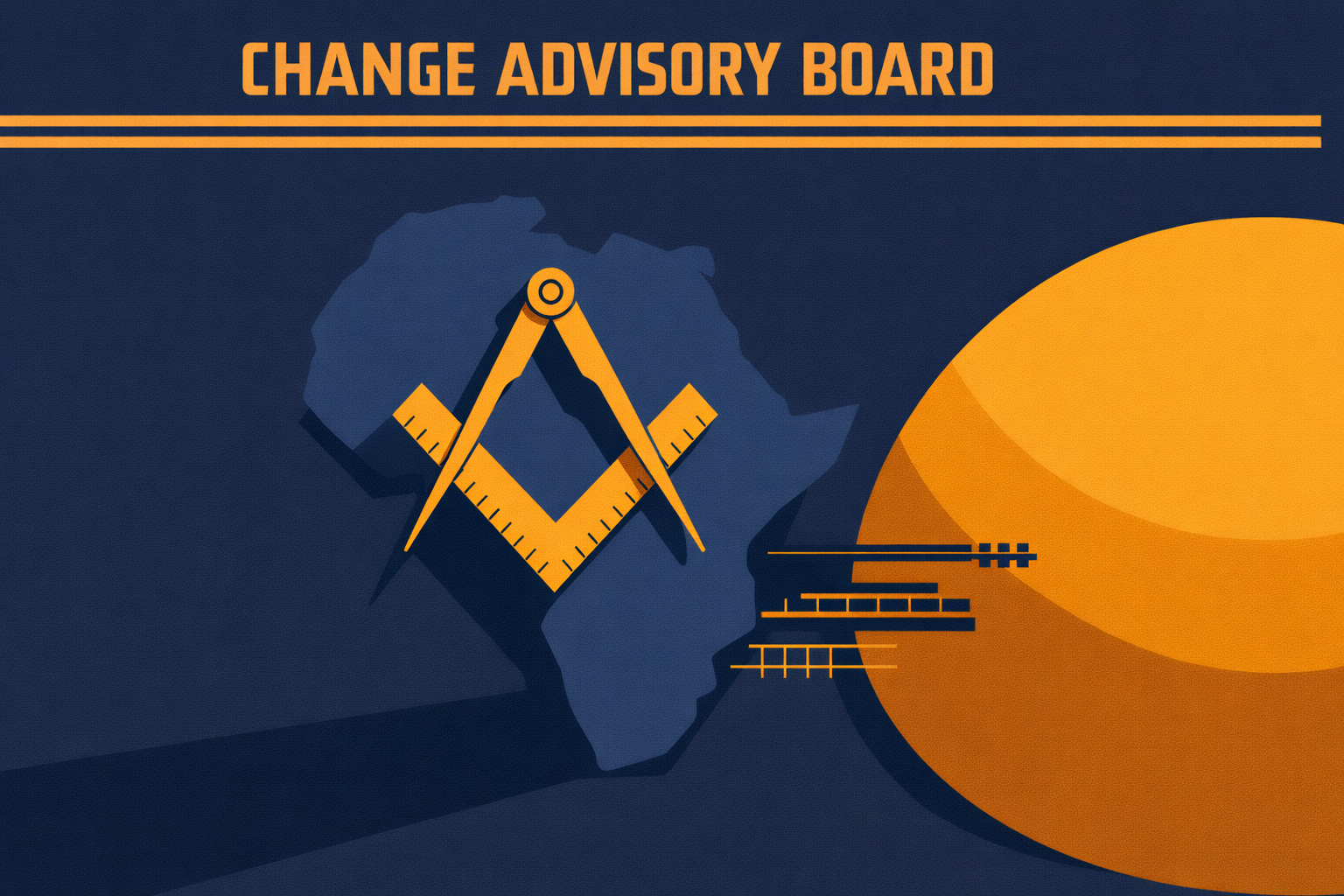
    China’s expanding presence across Africa is often described in terms of infrastructure, resource extraction, security agreements, and spheres of influence. In this episode of The Change Advisory Board, we examine the China–Africa relationship through a different lens—one rooted not in economics or diplomacy, but in an older moral operating system.

    Using the Masonic working tools of the Square, Level, and Plumb, this episode treats modern statecraft as a system under ethical stress. Rather than asking whether China’s engagement in Africa is “good” or “bad,” we ask a more difficult question: can moral integrity survive inside a sphere of influence at all?

    We trace the historical presence of Freemasonry in both China and Africa to establish the ethical framework, then analyze China’s four strategic pillars on the continent—political leverage, resource security, security guarantees, and ideological projection. These ambitions are tested against real-world instability, including events in the Great Lakes region and the collapse of externally brokered peace efforts in the Democratic Republic of Congo.

    Throughout the episode, we distinguish necessity from virtue, examining where partnerships appear to meet on the level—and where overwhelming material interests bend the plumb and unbalance the square. The result is not a partisan judgment, but a sober diagnosis of the structural limits of moral perfection in nation-state behavior.

    This episode is for listeners interested in ethics, systems thinking, and the tension between moral ideals and geopolitical power.

    Sources

  • The Common Gavel vs. The Comments Section

    The Common Gavel vs. The Comments Section

    The Problem: Signal-to-Noise Ratio

    As IT professionals, we know that looking for a root cause in a log file full of garbage data is a waste of time. Yet, every day, we voluntarily open the “error logs” of the internet: the comments section.

    We scroll looking for insight or humor (the Signal), but we mostly find rage bait, bots, and ad-hominem attacks (the Noise). We tell ourselves we’re just “staying informed” or “seeing what people think,” but neurologically, we are just exposing our brains to an unmoderated exploit. We get riled up, we lose focus, and we waste bandwidth that should belong to our work and our families.

    The Philosophy: The Common Gavel

    In Freemasonry, we are taught to use the Common Gavel to break off the “rough and superfluous parts” of the stone, fitting it for the builder’s use. It is a tool of divestment. It removes what doesn’t belong so the true form can be revealed.

    The comments section on 99% of websites is “superfluous.” It adds no structural integrity to your life. It is rough, jagged, and useless for building anything of value.

    The Solution: A Technical Control

    Willpower is a finite resource. Don’t rely on it. Instead, apply a technical control.

    I recently realized that trying to ignore the comments is like trying to ignore a blinking red alert on a dashboard. The “Admin” solution isn’t to stare at it harder; it’s to patch the vulnerability.

    I installed a browser extension that simply strips the comments section out of the code before it renders on my screen.

    • The Result: I watch the content, absorb the information, and then… I move on.
    • The Masonic Application: I have used a modern tool to physically break off the superfluous part of the internet.

    The Change Advisory Board Recommendation

    We cannot control the chaos of the internet, but we can control our interface with it. If you find yourself losing 20 minutes to a flame war you aren’t even participating in, it’s time to pick up your Gavel (or your browser extension) and clean up your stone.

    Action Item: Install a comment blocker today (like “Unhook” for YouTube or “Shut Up” for the web). Reclaim your CPU cycles for the applications that actually matter.

  • Engineering Principles Are Moral Blueprints

    Engineering Principles Are Moral Blueprints

    This episode of Change Advisory Board is a deep dive for mechanics, technicians, and engineers who live every day inside load tables, torque specs, tolerances, and fluid systems—but may not have considered that these technical disciplines are also moral ones.

    We explore how the core principles of engineering mechanics—statics, dynamics, geometry, material science, and energy management—form a direct parallel to the ancient moral architecture preserved in Freemasonry. Concepts like moment of inertia, section modulus, lever equilibrium, fastener preload, tolerance classes, hydraulic pressure, thermal regulation, and metallurgical tempering are examined not only as physical necessities, but as ethical blueprints for building a stable life and character.

    Using real mechanical examples—from beam geometry and bolt stretch to Pascal’s Principle, cooling system failures, and heat-treated steel—we show how wisdom, strength, and beauty are not abstractions, but operational requirements. Wisdom is foresight and calculation. Strength is material integrity and disciplined execution. Beauty is harmony: the efficient, resilient system that performs as intended without waste or collapse.

    The episode bridges operative masonry and speculative philosophy, tracing how geometry has always been treated as a sacred language of creation—from ancient China and Egypt, through cathedral builders and Enlightenment thinkers, to the modern shop floor. The tools of the craft—the gavel, square, plumb, and compasses—are revealed as precision instruments for both machines and men.

    For technicians who take pride in doing things right, this episode argues that your daily work is already a moral practice. When performed with accuracy, restraint, and respect for immutable laws, engineering is not just labor—it is a lived philosophy.

    Sources

  • The Gavel, the Gauge, and the Broken Foundation

    The Gavel, the Gauge, and the Broken Foundation

    This episode confronts one of the most difficult crises a person can face: the collapse of life under addiction—and the parallel responsibility of a fraternity committed to lifting a worthy brother in distress. Through a dual lens of Alcoholics Anonymous and Freemasonry, we explore addiction not as a moral failure but as a physical abnormality paired with a devastating mental distortion: the loss of perspective that allows a person to take the first drink despite knowing the consequences.

    We trace the progression from physical compulsion to shattered resolve, isolation, self-deception, and the spiritual walls that keep so many trapped. Then we walk through the architecture of recovery: surrender, moral inventory, confession, character repair, and sustained service. Each phase of the Twelve Steps is examined as a disciplined reconstruction of a man’s inner foundation.

    From there, we map these principles directly onto the Craft’s moral blueprint. The common gavel becomes the tool of inventory. The 24-inch gauge becomes the mandate for service. The Lewis symbolizes the fraternity’s duty to bear the burden of a fallen brother. The immovable jewels provide the moral geometry for rebuilding a life upright.

    The result is a unified framework: the spiritual labor of recovery reinforced by the symbolic architecture of Freemasonry. Both insist that the highest attainment comes through humility, self-examination, and service. And both reveal that profound suffering, when met with discipline and fellowship, can become the accelerated path toward becoming a true operative builder.

    Source #01: Alcoholics Anonymous 4th Edition

    Source #02: The Builders. A Story and Study of Masonry by Joseph Fort Newton, Litt. D. 

    Source #03: The Lecture of the First Degree of Freemasonry

    Source #04: Entered Apprentice Lecture by phoenixmasonry.org

    Source #05: The Lecture of the Second Degree of Freemasonry

  • Stone, Soul, and Software

    Stone, Soul, and Software

    The philosophical principles underlying human conduct and ancient wisdom traditions establish a framework for understanding order and morality. Marcus Aurelius emphasized that the body is perishable, merely a “little flesh and breath” or a “network, a contexture of nerves, veins, and arteries”, while the rational soul should seek to know itself and choose its own nature. The end for rational animals is to follow reason, be content with destiny, and understand that the Universe is transformation. This pursuit of wisdom is paralleled in Freemasonry, which holds that all elevating and benign religions share fundamental truths. Masonry, founded on Geometry, or the fifth science, utilizes symbols like the Rough Ashlar, representing the unpolished mind awaiting cultivation through liberal education, and the pillars Boaz and Jachin, which denote strength and stability.

    Ancient texts, particularly the King James Version (KJV) of the Bible, have shaped modern language and literature. The KJV has contributed more to English than perhaps any other literary source, providing phrases like “The spirit indeed is willing, but the flesh is weak” (Matthew 26:41) and introducing words like helpmate, derived from “help meet for him” in Genesis. Its influence is evident across English literature in works by Shakespeare, John Milton (Paradise Lost), Herman Melville (Moby-Dick), and C.S. Lewis. The original KJV included the Old Testament, New Testament, and the Apocrypha, though the Apocrypha was later removed in the 1800s by scholars concerned about contradictions and whether the books were divinely inspired. The KJV is textually connected to the Textus Receptus, and resources like the King James Bible Dictionary exist to clarify its content, covering topics such as Strong’s Numbers.

    In modern technology, Site Reliability Engineering (SRE) embodies a structured approach to maintaining complex systems, focusing on reliability as the “most fundamental feature of any product”. SRE, which originated from asking a software engineer to design an operations team, caps operational work (toil)—defined as manual, repetitive work that scales linearly—at 50% of an engineer’s time to ensure focus on engineering projects. Core SRE principles include managing service risk using error budgets, employing automation to maximize consistency and reduce costs, and utilizing distributed consensus algorithms like Paxos and Chubby to manage critical state reliably across failures. Monitoring is essential, prioritizing actionable alerts (immediate human intervention) and classifying outputs clearly (Alerts, Tickets, Logging). These practices, particularly preparedness, postmortem analysis, and automation, align with fundamental lessons learned across other high-reliability industries, such as the nuclear navy, defense, and aviation.

    Source #01: Site Reliability Engineering edited by Betsy Beyer, Chris Jones, Jennifer Petoff, and Niall Richard Murphy

    Source #02: Contribution of the King James Bible to the English Language – International Journal of Applied Research

  • The Level and the War-Forge

    The Level and the War-Forge

    This episode traces a sharp line between the Masonic Level—symbol of equality, humility, and shared human destiny—and the immense industrial architectures that manufacture the tools of modern warfare. The Level teaches that all people stand on common ground, “partakers of the same nature,” and that death is the great equalizer that dissolves rank and distinction. Yet the defense industry operates on a different plane entirely: profit-driven hierarchies crafting weapons that divide, destroy, and stratify the world.

    We explore this philosophical collision with care. On one side stands the Fellow Craft’s call to upright living, unity, and the quiet moral geometry of the Level. On the other stands ITAR-governed corporate machinery—engineers, factories, algorithms, supply chains—shaped to produce precision instruments of organized violence. Between them lies a chasm where ethics, economics, and power intersect. This episode asks what becomes of equality when the tools we craft are designed to end lives, not harmonize them—and whether moral architecture can survive inside an industry built on coercion, secrecy, and profit.

    Source #01: Contractors as Military Professionals? by Gary Schaub Jr. & Volker Franke

    Source #02: Ethical Dilemmas in the Global Defense Industry by Daniel Schoeni & Tobias Vestner

    Source #03: What Is ITAR Compliance? by CloudEagle.ai

    Source #04: The Ethics of Defense and Private Security Contracting by George Lucas

  • The Canopy and The Starfield

    The Canopy and The Starfield

    This episode explores the shared sky between Masonry and Starfield—a symbolic canopy that says more about human purpose than it does about stars. In Masonry, the Celestial Canopy stretches from the lodge room to the edge of creation, reminding the initiate that the universe itself is the Temple of the Grand Architect. In Starfield, that same vastness becomes the stage for Constellation’s search for the Unity: a literal attempt to pierce the heavenly veil and discover what truth, if any, lies beyond it.

    We draw parallels between the Lodge’s starry firmament and the cosmic expanse the player navigates. Where Masonry uses the canopy as a moral reminder—boundless charity, an infinite pursuit of light—Starfield transforms it into a philosophical battleground. Sanctum Universum, the Enlightened, and House Va’ruun echo the ancient triad of Beauty, Wisdom, and Strength as they debate what lives behind the cosmic curtain. Constellation’s Lodge stands alone as the one institution content to search without dogma, mirroring the Craft’s insistence that truth must be discovered, not inherited.

    The episode follows this shared journey beneath the vault of heaven: from the Mason’s quiet moral ascent to the traveler’s leap into the Unity. Both paths lead toward a revelation that is less about cosmology and more about character. Whether walking the mosaic pavement or drifting through the nebulae of the Settled Systems, the seeker confronts the same question age after age—what does it mean to find light in a universe that refuses easy answers?

    By the end, the canopy becomes something more than a roof or a sky. It becomes the infinite canvas where meaning is made, where the Lodge and the Starfield overlap, and where the search for truth continues in every universe the traveler is willing to explore.

    Source #01: Searching for God in Starfield

    Source #02: What Is The Best Starting Religion In Starfield? by Alexander Maksymiw

    Source #03: The Lecture of the First Degree of Freemasonry

    Source #04: The Builders. A Story and Study of Masonry by Joseph Fort Newton, Litt. D.