When a multimillion‑dollar software system crashes, everyone wants the clean, binary answer you get from an X‑ray: broken or not broken, this is the exact fracture. In reality, the diagnostic “film” is clouded by human ego, terrified engineers, and executives demanding that someone—anyone—be fired immediately. This episode of The CAB Call, “Magna Est Veritas: From Persian Kings to Blameless Postmortems,” explores how to find truth when human nature is practically begging everyone to lie.
Episode overview
The episode opens with a simple contrast: in medicine, a broken arm shows up as a jagged white line on an X‑ray, but in complex organizations, that line is smeared by politics, fear, and incentives. When a major system fails, the mechanical truth of what happened is difficult to expose precisely because the people closest to it are terrified of the consequences.
To understand how truth can ever prevail in that environment, you walk listeners through a layered stack of sources. You start with the apocryphal book of 1 Esdras in the Persian Empire, then examine how the Masonic Order of the Red Cross codified those ideas into ritual, and finally map them directly onto modern practices like SSOT architectures and blameless postmortems. The through‑line is consistent: truth is great, and it will prevail—if we are willing to submit our egos to it.
Truth in the court of King Darius
The first major section dives into 1 Esdras 3–4, set during the reign of Darius in the Persian Empire. Jerusalem lies in ruins, the Jewish people are trying to rebuild their temple, and political progress is stalled when the story zooms into the king’s court for the “immemorial discussion.” Three royal guards decide to hold a high‑stakes rhetorical contest: each writes down a single sentence on what is the strongest force in the world, and slips it under the king’s pillow, wagering massive honor and wealth on the outcome.
The first guard argues for wine as the strongest force, not because of its flavor, but because it “leaves astray the minds of all who drink it.” Wine becomes the great eraser of reality, dissolving debts, sorrows, and even allegiances, equalizing king and slave in chemically induced forgetfulness. The second guard plays to the room by arguing for the king’s power, pointing at Darius himself as the embodiment of terrifying temporal authority: command to march, and armies march; command to build or destroy, and labor and spoils flow without question.
The third guard, Zorobabel, answers in two stages. First, he pivots to women and emotion, pointing out that men will abandon parents, betray countries, and surrender wealth just to cleave to a woman—and even the great Darius bends under a concubine’s influence. Then he makes his real move: he argues for the sovereignty of truth, declaring that “truth is great and stronger than all things… it prevails forever and ever.” Wine is wicked, kings are wicked, and human passions are wicked in the sense that they are subject to decay and error, but truth is impartial, incorruptible, and unmoved by bribes, swords, or emotional attachments.
“Magna est veritas” as an operating system
The court erupts at this argument, shouting “Magna est veritas, et praevalebit”—great is truth, and it will prevail—as Darius grants Zorobabel’s request to return the holy vessels and rebuild the temple. The key mechanism is not that truth is nicer or more comforting; it is that bridges fall, empires rise and collapse, and systems fail regardless of what anyone believes about them. A collapsed bridge is a collapsed bridge whether the king approves or not, and the same is true of a corrupted database or broken failover plan.
You translate this directly into a modern boardroom. Contemporary companies still worship the same three “false idols” described in the story: wine becomes the intoxicating hype cycle of stock price and corporate perks, kings become CEO mandate and executive ego, and women/emotion become marketing, branding, and consumer manipulation. Into that room walks the modern Zorobabel—the SRE, lead systems engineer, or data scientist—who insists that the only thing keeping the enterprise from burning down is the raw, objective truth of the system’s data and telemetry.
The Masonic Order of the Red Cross as “narrative technology”
The episode then uses the Illustrious Order of the Red Cross in the York Rite of Freemasonry as a historical “translation layer” that preserves this philosophy of truth. Thomas Smith Webb’s 1797 Freemasons’ Monitor is presented as a kind of organizational architecture that took scattered legends and degrees and assembled them into a coherent “narrative technology.” The Red Cross solves a structural problem in the Masonic journey: how to bridge an Old Testament, temple‑focused narrative into a Christian chivalric order without breaking immersion.
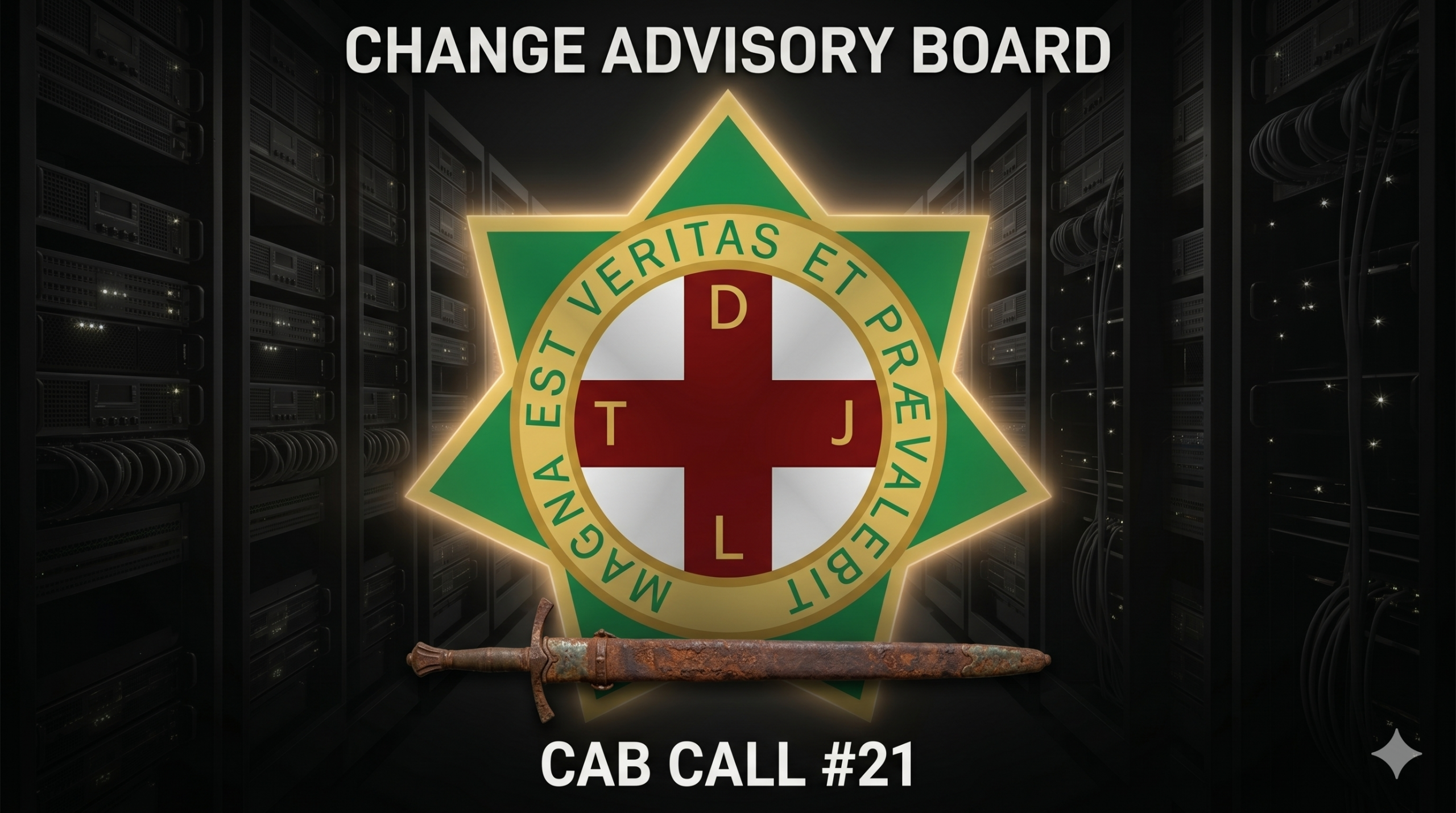
The bridge is built using truth as a universal data format. In the ritual, the candidate effectively re‑enacts Zorobabel’s journey to the Persian court, with the Order of the Red Cross acting as a psychological API between the “operating system” of the Old Testament and the “operating system” of the New Testament. Symbols are standardized in the 1892 Denver revision: the green banner of hope with a seven‑pointed star bearing “Magna est veritas et praevalebit,” and the red jewel cross inscribed with D‑T‑J‑L—Deity, Truth, Justice, Liberty.
Those four letters are treated as the system’s core operating principles. Deity signifies recognition of an ultimate God of truth; Truth is the sovereign, impartial reality; Justice is truth applied to human affairs; and Liberty is the freedom that results when truth and justice function properly. The ritual even includes a physical bridge engraved with “LDP LDP” (Libertas Passe, liberty of passage), interpreted by Albert Pike as liberty of thought, speech, and action granted by objective knowledge.
The sword, DTJL, and psychological impartiality
The most striking piece is the sword given to Zorobabel for his journey across the bridge. The ritual is explicit that this sword is not a weapon of aggression, but an instrument solely to defend truth, with a vow that it must never be drawn in the cause of injustice, falsehood, or oppression. Candidates are instructed to let the sword rust in its scabbard rather than draw it even once in the defense of a lie. This is framed not just as a pledge to “be good,” but as a vow of extreme impartiality: protect objective truth even if it costs your position, your comfort, or your safety.
You connect this directly to organizational resilience. If leaders use their “sword”—administrative power, voice, and influence—to attack subordinates in order to protect their own reputation, they violate the very architecture of resilience the ritual encodes. The Masonic sources argue that, because truth is divine and impartial, human systems that want to survive must attempt the same impartiality: no punishing people for bad news, no incentives to hide the truth, and no rewarding of spin over telemetry. That becomes the baseline psychological standard by which you evaluate modern tech and corporate practices.
Single Source of Truth (SSOT) as a modern “temple”
From there, the episode shifts into contemporary primary sources on Single Source of Truth (SSOT) design. The KPI Fire documentation you reference defines SSOT not as a specific database product, but as a state of being for company data: centralized, consistent, accessible, and scalable. Multiple versions of the truth scattered across dashboards and spreadsheets are described as catastrophic, leading to paralysis, contradictory narratives, and politically driven decision‑making.
You illustrate this with a concrete scenario: marketing’s dashboard says 10 million in revenue, engineering’s system shows 8–9 million in server spend, and the C‑suite’s spreadsheet says everything is highly profitable. Each group is living in a different reality, and the loudest executive wins rather than the person with the most accurate data. The SSOT exists to force every ego in the building to bow to the same objective facts, just as the rebuilt temple and its vessels gave the Jewish community a central, unified focus in the ancient narrative.
Blameless postmortems as ritualized truth‑seeking
The next layer is SRE and blameless postmortems. You walk through a modern failure scenario: a large cloud platform goes down, dollars vaporize by the minute, and the primal instinct is to find who typed the wrong command and fire them on the spot. SRE literature argues that if you want a true SSOT after an incident, engineers must feel psychologically safe enough to tell the unvarnished story of what happened. Fear triggers fight‑or‑flight responses, and frightened humans lie or omit details to survive.
A well‑run blameless postmortem is portrayed as a ritual with its own strict rules. The process bans “who” and “why” questions, which attack character and trigger defensiveness, and instead insists on “how” and “what”: how the system failed, what processes were missing, what signals were visible at each step. Pronouns are policed: “we missed a step” replaces “you didn’t check,” turning the meeting from a hunt for a culprit into a collaborative reconstruction of reality. You explicitly frame this as a modern execution of the Red Cross vow: the engineers are sheathing their swords of blame so that the objective timeline can be preserved.
Scapegoats, false accountability, and Agatha Christie endings
The final tier of sources is opinion writing on false accountability and the scapegoat mechanism. These pieces argue that public culture often equates accountability with visible punishment—prison sentences, public firings, and spectacle—while allowing structural rot to continue unexamined. Drawing on René Girard’s mimetic theory, you describe how communities in crisis unconsciously collude to load systemic sins onto a single victim and expel them to release tension.
An analogy from Guido Vilo likens this to an Agatha Christie novel: the village is anxious after a crime, everyone is a suspect, and peace is restored only when a brilliant detective reveals a single murderer who is led away in handcuffs. Real complex systems do not behave that way—failures are emergent results of many interacting factors—but organizations still crave that narrative simplicity. When leaders treat incidents like murder mysteries, they may feel emotionally satisfied, but they guarantee that logs will be altered, evidence will vanish, and the system will fail again.
Closing challenge: is your system ruled by truth or fear?
The episode closes by pulling all layers together: 1 Esdras shows truth outlasting wine, kings, and emotion; the Order of the Red Cross codifies that insight into DTJL and a vow to keep the sword sheathed; SSOT architectures and blameless postmortems build literal and cultural temples to the same idea in the digital age. Opposing all of this is the deeply ingrained scapegoat impulse and a false culture of accountability that treats punishment as a substitute for understanding.
You end by asking listeners to examine their own organizations, families, and relationships. If truth truly is the almighty force that outlasts empires, what “logs” are they hiding because they treat people around them like punitive King Darius instead of allies in the search for reality? A culture of punishment builds fragile, doomed systems; a culture of truth builds resilient ones.