
Tag: SRE principles

  • The Secret Master

    The Secret Master

    Click here to display content from html5-player.libsyn.com.

    Secret Masters & Site Reliability: Scottish Rite Freemasonry Meets SRE, Cybersecurity, and the Ethics of AI

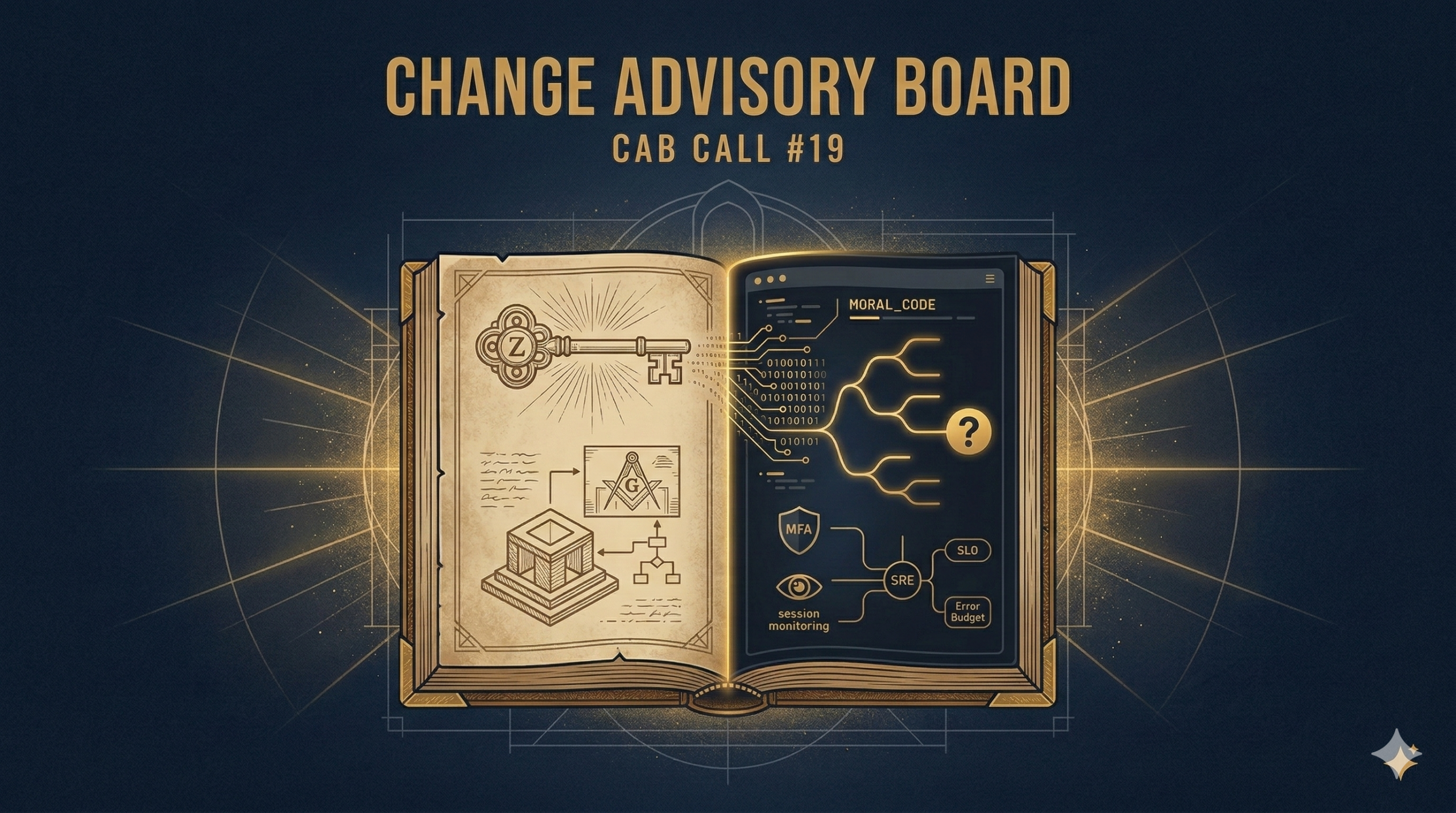
    This episode of The CAB Call explores parallels between Scottish Rite Freemasonry—especially the 4th degree Secret Master—and modern site reliability engineering and cybersecurity. Using sources like Pike’s Morals and Dogma, Clawson’s Commentaries, SRE (O’Reilly), guidance on privileged user responsibilities, and Phil Rogaway’s arguments about cryptography, it frames the Scottish Rite as an “expansion pack” dependent on the Blue Lodge foundation, where loss of Blue Lodge standing ends Scottish Rite membership. It compares Masonic study aids such as A Bridge to Light and the Ritual Monitoring Guide to SRE runbooks, emphasizing critical thinking over rigid dogma. The discussion maps SRE error budgets, CI/CD iteration, observability, least privilege, MFA, session monitoring, and blameless postmortems onto Masonic ideals of duty, secrecy, human fallibility, and pursuit of light, ending with questions about what moral code will be embedded into autonomous AI systems.

    00:00 Welcome and Premise

    01:20 Sources and Core Question

    02:42 Blue Lodge Base Layer

    05:31 Cognitive Load and Runbooks

    08:29 Critical Thinking Over Dogma

    10:04 Error Budgets and Fallibility

    13:26 Continuous Improvement and Rebuilds

    15:18 Secrecy Versus Observability

    20:35 Incident Response and Duty

    24:16 AI and Cyber Civility

    25:56 Summary and Final Questions

    Sources

  • The Architecture of Eternity

    The Architecture of Eternity

    Click here to display content from play.libsyn.com.

    Freemasonry’s Moral OS and the Birth of Human Reliability

    This episode of The Cab Call traces the long arc of Masonic history as if it were the version-history of humanity’s oldest moral operating system. Instead of treating the Craft as a museum of rituals, we explore it as a living reliability framework—prophecy, practice, and interpretation—evolving over thousands of years to keep human beings resilient in a world full of entropy.

    We move from the prophetic era, where symbols like the Cube and Square encoded universal laws of stability, through the great operative builders who carried those laws through collapsing empires and dark ages. The Comacine Masters, the Roman Collegia, the cathedral architects—all appear not as quaint historical footnotes but as early maintainers of an ethical architecture designed to produce both strong buildings and strong men.

    The episode follows the rise of Speculative Masonry, when the craft stopped building cathedrals and began building character instead, and culminates with the 1717 Grand Lodge—the moment Masonry became a universal, non-sectarian system for producing “Good men and True.” Across the entire journey, we frame the fraternity as a blueprint for human reliability engineering: an attempt to harmonize fallible people with immutable moral laws the same way an engineer harmonizes fallible systems with physical ones.

    It’s an episode about continuity across collapse, symbols that outlast empires, and why an ancient institution built for stoneworkers still feels modern in an era of distributed systems and digital drift.

    Source #1: The Builders. A Story and Study of Masonry by Joseph Fort Newton, Litt. D.