When the Map Becomes the Test
 Nicholas King (via Libsyn)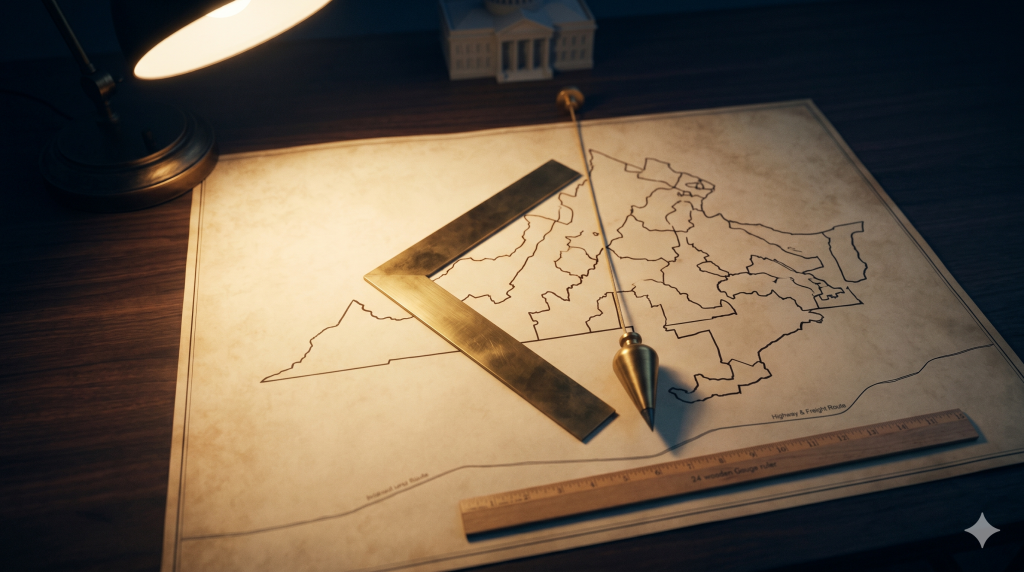
The Square tests the line; the Plumb tests the reason it was drawn.
Meet on the Level, act by the Plumb, part upon the Square.
The Day in Brief
- Voting Rights Act ruling narrows the mapmakers’ line: The Supreme Court’s Louisiana v. Callais decision remains the day’s strongest civic thread because it reshapes how courts judge race, district maps, and Section 2 of the Voting Rights Act.
- Immigration court oversight becomes a public test: A Lower Manhattan federal immigration court has become a symbol of enforcement, oversight, protest, and electoral accountability in New York.
- Freight broker liability reaches the safety exception: The Supreme Court revived a suit against a major logistics broker, tying transportation law to public safety and accountability.
The Working Tools Used Today
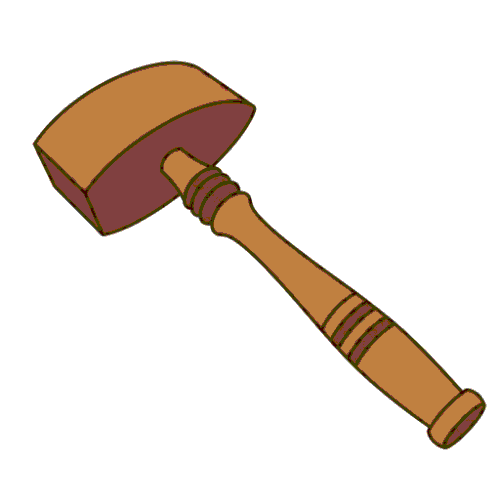 Common Gavel Common Gavel | The Common Gavel is an instrument used by operative masons to break off the corners of rough stones, the better to fit them for the builder’s use; but we, as Free and Accepted Masons, are taught to make use of it for the more noble and glorious purpose of divesting our hearts and consciences of all the vices and superfluities of life. |
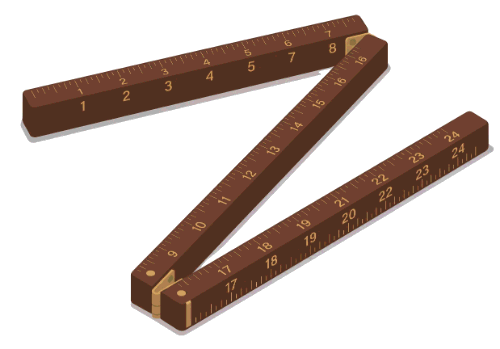 24-Inch Gauge 24-Inch Gauge | The Twenty-Four-Inch Gauge is an instrument used by operative masons to measure and lay out their work; but we, as Free and Accepted Masons, are taught to make use of it for the more noble and glorious purpose of dividing our time. It being divided into twenty-four equal parts, is emblematic of the twenty-four hours of the day, which we are taught to divide into three equal parts, whereby we find eight hours for the service of God and a distressed worthy brother, eight for our usual vocations, and eight for refreshment and sleep. |
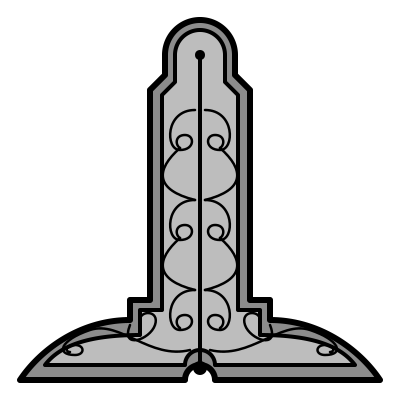 Level Level | The Level is an instrument used by operative masons to prove horizontals; but we, as Free and Accepted Masons, are taught to make use of it for the more noble and glorious purpose of walking upon the level of time with all mankind, and to remind us that we are traveling upon the level of time to that undiscovered country from whose bourn no traveler returns. |
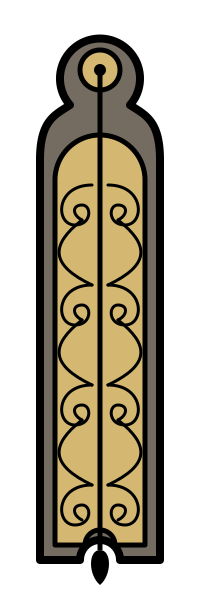 Plumb Plumb | The Plumb is an instrument used by operative masons to try perpendiculars; but we, as Free and Accepted Masons, are taught to make use of it for the more noble and glorious purpose of admonishing us to walk uprightly in our several stations before God and man. |
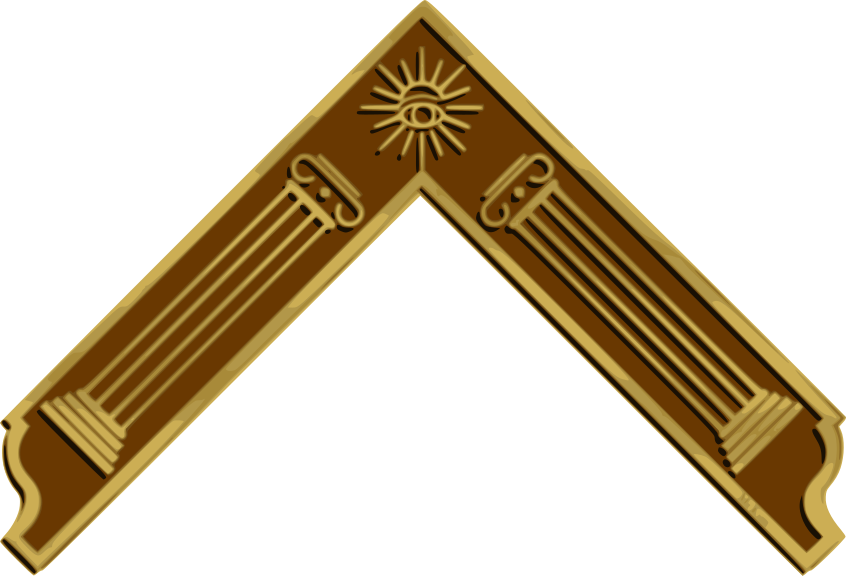 Square Square | The Square is an instrument used by operative masons to square their work; but we, as Free and Accepted Masons, are taught to make use of it for the more noble and glorious purpose of squaring our actions by the Square of Virtue. |
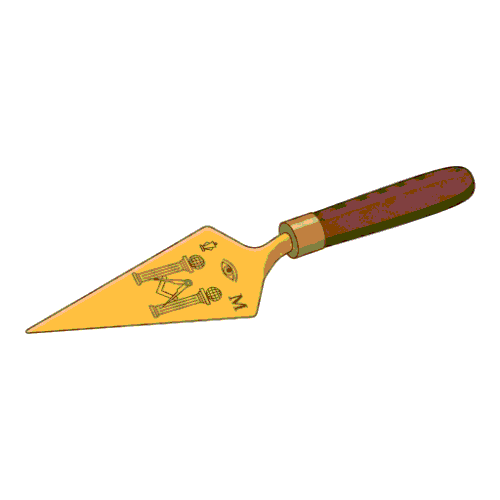 Trowel Trowel | The Trowel is an instrument used by operative masons to spread the cement which unites a building into one common mass; but we, as Free and Accepted Masons, are taught to make use of it for the more noble and glorious purpose of spreading the cement of brotherly love and affection, that cement which unites us into one sacred band of friends and brothers. |
Voting Rights Act ruling narrows the mapmakers’ line
The record currently shows that the Supreme Court decided Louisiana v. Callais on April 29, affirming a lower-court judgment that Louisiana’s SB8 congressional map was an unconstitutional racial gerrymander. The opinion says Section 2 of the Voting Rights Act can sometimes give a compelling interest for race-conscious districting, but the Court held that Louisiana’s map went beyond what the Constitution allows. Harvard’s Kennedy School describes the ruling as weakening key Voting Rights Act protections, while the Brennan Center argues that the decision narrows one of the statute’s remaining tools for challenging discriminatory election systems. For readers, the issue is not only who wins a seat. It is whether public lines are drawn by a durable rule, or by power looking for a safer path. Sources: Supreme Court opinion in Louisiana v. Callais; Harvard Kennedy School on Louisiana v. Callais; Brennan Center analysis of Louisiana v. Callais.
| Common Gavel | What slogans should citizens chip away before looking at the legal test for race, district maps, and constitutional limits? |
| 24-Inch Gauge | How should election deadlines be measured before confusion becomes the rule? |
| Level | Do voters meet the map on equal civic ground, without districts drawn to magnify some voices and diminish others? |
| Plumb | Can officials explain maps uprightly by law and evidence rather than convenience? |
| Square | Do district lines match equal protection, statutory duty, and fair representation at the same time? |
| Trowel | Can law bind losers and winners to one civic frame, or will citizens see rules as tools of the winning side? |
Masonic Assessment: The available facts suggest the parties met on the Level only if every voter can see a fair path from community to representation. The Plumb rests on candor about why lines were drawn. The Square is the hard edge of constitutional review, and the Trowel remains uncertain because trust in election law is still being repaired.
Sources: Supreme Court opinion in Louisiana v. Callais; Harvard Kennedy School on Louisiana v. Callais; Brennan Center analysis of Louisiana v. Callais.
Immigration court oversight becomes a public test
According to the sources, the Jacob K. Javits Federal Office Building at 26 Federal Plaza has become a flashpoint for immigration enforcement and public oversight. The Associated Press reports that the site is central to a New York Democratic primary between Rep. Dan Goldman and former city Comptroller Brad Lander. The records describe two different responses to the same civic pressure: formal oversight, lawsuits, and constituent triage on one side; protest, court observation, and arrest risk on the other. WTOP republished the AP account and reported that Goldman’s campaign said his office helped more than 30 people gain release from federal custody. The matter remains unresolved because the basic question is institutional: when enforcement moves into a courthouse hallway, what does public accountability require? Sources: Associated Press on 26 Federal Plaza and the House race; Washington Post republication of the AP account; WTOP republication of the AP account.
| Common Gavel | What performance should public actors remove so attention returns to people, process, and verifiable facts? |
| 24-Inch Gauge | How should time spent in hearings, lawsuits, public witness, and direct constituent work be measured? |
| Level | Are migrants, officers, lawyers, candidates, and voters treated as human beings before they become symbols? |
| Plumb | Can enforcement and oversight stand upright in a courthouse setting where fear and power are close together? |
| Square | Does each response, whether formal oversight or protest, remain bounded by law and public duty? |
| Trowel | Can public argument lead to clearer rules, safer hearings, and less contempt between neighbors? |
Masonic Assessment: The record currently shows people trying different tools under pressure. They meet on the Level when the human stakes are not hidden behind procedure. They act by the Plumb when witness is truthful, and they part upon the Square only if the courthouse remains a place of law rather than spectacle. The Trowel is present only in repair.
Sources: Associated Press on 26 Federal Plaza and the House race; Washington Post republication of the AP account; WTOP republication of the AP account.
Freight broker liability reaches the safety exception
The Supreme Court’s Montgomery v. Caribe Transport II decision gives today’s court theme a practical industrial edge. The official opinion says the case arose from a collision involving a tractor-trailer, a motor carrier, and a broker. The Court addressed whether the Federal Aviation Administration Authorization Act preempts state-law negligent-hiring claims against freight brokers. According to AP, the unanimous ruling lets Shawn Montgomery proceed with a suit against C.H. Robinson after he lost part of his leg in a crash. Faegre Drinker’s legal analysis says the Court held that the claim fits within the FAAAA’s safety exception. In that light, public safety becomes more than a rulebook. It becomes a question of who checked the carrier, who had reason to know, and who must answer after harm. Sources: Supreme Court opinion in Montgomery v. Caribe Transport II; Associated Press on the freight broker ruling; Faegre Drinker analysis of Montgomery v. Caribe Transport II.
| Common Gavel | What rough assumption about freight brokers and safety choices should be removed? |
| 24-Inch Gauge | What checks should occur before freight moves, not only after a crash enters litigation? |
| Level | Are injured drivers, brokers, carriers, shippers, and consumers placed within the same public-safety system? |
| Plumb | Can a broker’s selection process stand upright when measured against known carrier safety information? |
| Square | How should the line between federal deregulation and state safety authority be squared? |
| Trowel | Can the ruling push the freight system toward cleaner responsibility rather than defensive blame? |
Masonic Assessment: The available facts suggest the parties met on the Level through a public court process after private injury. The Plumb asks for a straight account of broker selection. The Square appears in the Court’s safety-exception analysis, and the Trowel may appear if the industry turns the ruling into safer practice.
Sources: Supreme Court opinion in Montgomery v. Caribe Transport II; Associated Press on the freight broker ruling; Faegre Drinker analysis of Montgomery v. Caribe Transport II.
Closing Charge
The Voting Rights Act ruling is the clearest charge today: public lines must be measured before they are defended. When court oversight, immigration enforcement, and freight safety all depend on accountable process, the work is to test every claim before repeating it.
Let the Common Gavel remove appetite for easy certainty. Let the Square ask whether the result can bear the weight of law, neighbor, and conscience.
The Daily Working Tools is a personal moral reflection on public events using public sources. It does not speak for Freemasonry, any Lodge, or any Grand Lodge.