
Ebola Travel Ban at the Gate
 Nicholas King (via Libsyn)
Analyzing complex systems through the lens of foundational working tools.
Meet on the Level, act by the Plumb, part upon the Square.
The Day in Brief
- Ebola travel ban tests public health authority at the border: The Ebola travel ban leads today’s public record because a health order touches public safety, immigration status, and trust in emergency power.
- DNI resignation puts intelligence continuity on the clock: Tulsi Gabbard’s resignation places national intelligence continuity, personal duty, and transition planning in the same frame.
- Redistricting after Callais asks what equal representation means now: Redistricting remains a civic test after a Supreme Court voting-rights ruling altered the mapmaking incentives before the midterms.
- Learning recession data asks what schools owe students now: New reporting on the learning recession shows that student achievement problems began before the pandemic and still demand local repair.
The Working Tools Used Today
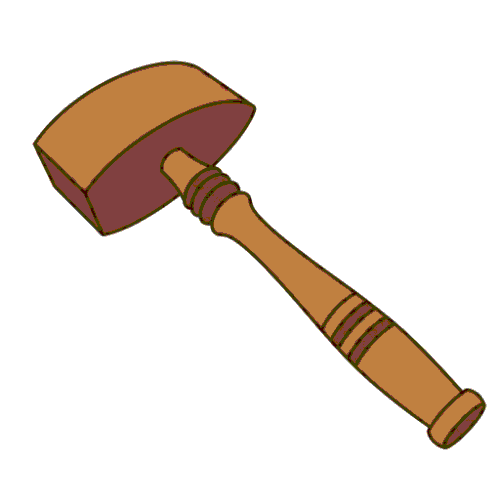 Common Gavel Common Gavel | The Common Gavel is an instrument used by operative masons to break off the corners of rough stones, the better to fit them for the builder’s use; but we, as Free and Accepted Masons, are taught to make use of it for the more noble and glorious purpose of divesting our hearts and consciences of all the vices and superfluities of life. |
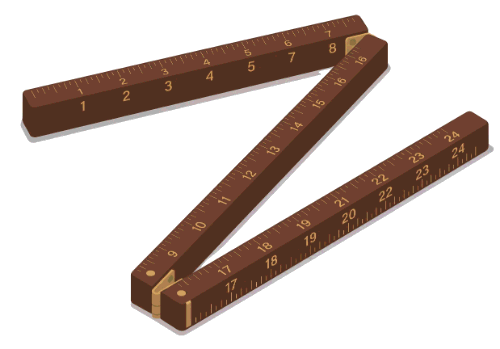 24-Inch Gauge 24-Inch Gauge | The Twenty-Four-Inch Gauge is an instrument used by operative masons to measure and lay out their work; but we, as Free and Accepted Masons, are taught to make use of it for the more noble and glorious purpose of dividing our time. It being divided into twenty-four equal parts, is emblematic of the twenty-four hours of the day, which we are taught to divide into three equal parts, whereby we find eight hours for the service of God and a distressed worthy brother, eight for our usual vocations, and eight for refreshment and sleep. |
 Level Level | The Level is an instrument used by operative masons to prove horizontals; but we, as Free and Accepted Masons, are taught to make use of it for the more noble and glorious purpose of walking upon the level of time with all mankind, and to remind us that we are traveling upon the level of time to that undiscovered country from whose bourn no traveler returns. |
 Plumb Plumb | The Plumb is an instrument used by operative masons to try perpendiculars; but we, as Free and Accepted Masons, are taught to make use of it for the more noble and glorious purpose of admonishing us to walk uprightly in our several stations before God and man. |
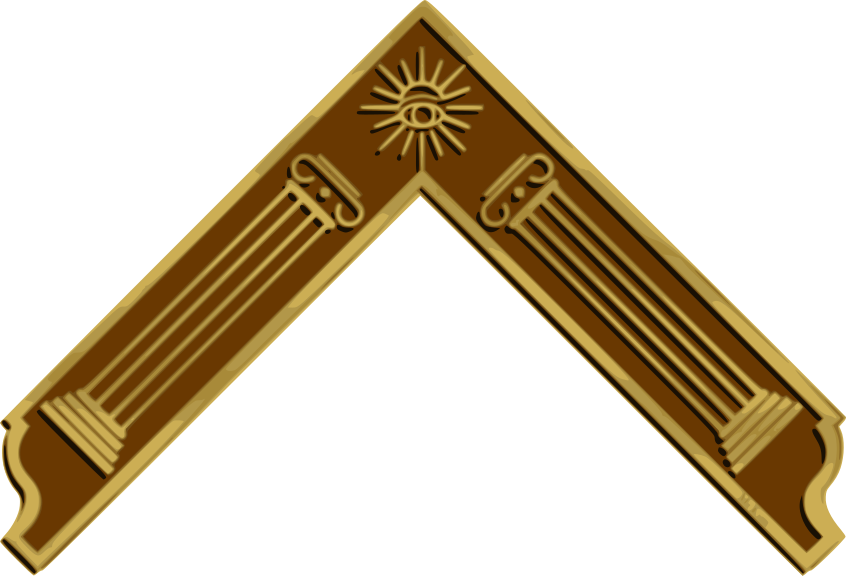 Square Square | The Square is an instrument used by operative masons to square their work; but we, as Free and Accepted Masons, are taught to make use of it for the more noble and glorious purpose of squaring our actions by the Square of Virtue. |
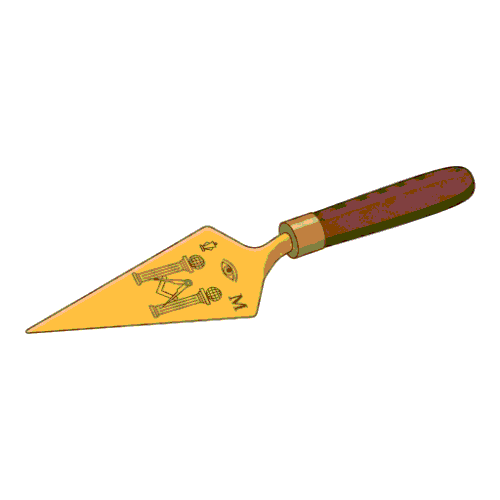 Trowel Trowel | The Trowel is an instrument used by operative masons to spread the cement which unites a building into one common mass; but we, as Free and Accepted Masons, are taught to make use of it for the more noble and glorious purpose of spreading the cement of brotherly love and affection, that cement which unites us into one sacred band of friends and brothers. |
Ebola travel ban tests public health authority at the border
According to the sources, the ebola travel ban rests on CDC Title 42 authority for a 30-day order tied to Ebola outbreaks in East and Central Africa, with public guidance saying certain non-U.S. citizens recently in DRC, Uganda, or South Sudan face temporary entry restrictions while U.S. citizens and nationals may return with screening and monitoring (CDC statement; CDC traveler guidance).
Reuters reported through Yahoo News that the ebola travel ban was extended to lawful permanent residents who had been in the three countries in the prior 21 days, a move the CDC described as balancing public health protection with emergency-response capacity (Reuters via Yahoo News). The matter remains unresolved because disease control depends on speed and candor, while affected residents need clear rules, medical facts, and a narrow path back to lawful entry.
Why the ebola travel ban matters
The ebola travel ban is also a public health order, a border rule, and a test of lawful status. The related terms matter because CDC authority, travel restrictions, lawful permanent residents, border screening, and 21-day monitoring all point to the same civic question: whether emergency power stays tied to evidence.
| Common Gavel | The first civic act is to remove fear, rumor, and careless certainty; without that restraint, public health becomes a test of loyalty rather than evidence. |
| 24-Inch Gauge | The strongest tension is time: a 30-day order and 21-day exposure window may be medically rational, but every added day raises the burden on lawful residents and families. |
| Square | The judgment turns on whether the order is narrow, reviewable, and tied to necessity rather than status alone. |
Verdict: The Square should govern the ebola travel ban, but only after the Gavel has cleared away panic. The available record supports a temporary health measure if it remains narrow, medically tied, and reviewable; it becomes harder to defend if lawful status turns into a shortcut for broad exclusion. Later facts about outbreak spread, exemptions, or renewal would decide whether the order stayed squared or became overreach.
Sources: CDC statement; Reuters via Yahoo News; CDC traveler guidance
DNI resignation puts intelligence continuity on the clock
The record currently shows that Tulsi Gabbard submitted her resignation as Director of National Intelligence effective June 30, citing her husband’s diagnosis with a rare form of bone cancer and saying she needed to be by his side (PBS resignation letter). PBS treated the move as a major administration shift in its May 22 broadcast (PBS NewsHour episode).
Al Jazeera reported that Principal Deputy Director Aaron Lukas would serve as acting director and placed the resignation inside a broader record of scrutiny over Gabbard’s tenure and intelligence decisions (Al Jazeera). The practical civic issue is not only who leaves office. It is whether a sensitive agency can preserve continuity, chain of command, and public confidence during a personal crisis and political transition.
DNI resignation and institutional continuity
The DNI resignation belongs beside the ebola travel ban because both stories test continuity under pressure. One asks whether a health rule can stay narrow; the other asks whether an intelligence office can keep authority clear while a personal crisis changes leadership.
| Level | The humane starting point is that family illness and public office both matter; treating either as a prop for factional argument distorts the record. |
| 24-Inch Gauge | The clock now governs the institution: the period before June 30 must be enough to preserve continuity, authority, and trust. |
| Plumb | The succession only stands upright if the administration names the acting authority and the unfinished work plainly. |
Verdict: The Level and the Plumb carry more weight here than the Trowel. The record points to a personal resignation that deserves human restraint, but the office still owes the public a clean succession. The verdict is that private duty can justify departure, while public duty requires a disciplined handoff; later confusion over authority would weaken that conclusion.
Sources: PBS resignation letter; PBS NewsHour episode; Al Jazeera
Redistricting after Callais asks what equal representation means now
According to the sources, the Supreme Court’s decision in Louisiana v. Callais held that Louisiana’s SB8 map was an unconstitutional racial gerrymander because Section 2 of the Voting Rights Act did not require the state to create the additional majority-minority district at issue (Supreme Court opinion). AP reported that the ruling is pushing Republicans in several states to consider or pursue new maps before election deadlines (Associated Press).
CFR’s analysis said the decision may affect the 2026 midterms by changing how states weigh partisan advantage, racial representation, and legal risk (Council on Foreign Relations). The matter remains unresolved because mapmaking is a technical legal act with human effects: district lines can decide whose voice is joined, divided, or made harder to hear.
Redistricting after Callais and public authority
Redistricting after Callais broadens the same theme from border authority to mapmaking authority. Public health orders, voting-rights rules, and election deadlines all require citizens to trust that technical decisions are not being used as cover for raw power.
| Level | The map must begin from equal civic standing, because district lines can make some voters easier to hear and others easier to ignore. |
| Square | The competing claim is legal: voting-rights protection, equal protection, and partisan incentive must be squared in the open rather than hidden behind technical lines. |
| 24-Inch Gauge | Election deadlines create pressure, but speed is not an excuse for drawing maps that citizens cannot understand or contest. |
Verdict: The Square is the controlling tool, with the Level pressing against it. A lawful map is not automatically a just map, and a representative map is not automatically lawful after Callais. The verdict is that speed should yield to transparent reasoning: if lawmakers cannot explain how equality, voting rights, and deadlines fit together, the map fails the civic test even before voters reach the polls.
Sources: Supreme Court opinion; Associated Press; Council on Foreign Relations
Learning recession data asks what schools owe students now
PBS reported that a new analysis found math scores down in 70 percent of districts and reading scores down in 83 percent compared with a decade ago, while eighth-grade reading sits at its lowest point since 1990 and chronic absenteeism remains near 25 percent (PBS NewsHour). Stanford said researchers from Stanford, Harvard, and Dartmouth found student achievement had been falling since 2013, before the pandemic accelerated the damage (Stanford Graduate School of Education).
Official NAEP long-term trend data shows 13-year-olds declined in both reading and math compared with 2019-20 and 2012-13 baselines (Nation’s Report Card). The civic issue is local and national at once. Scores measure children, but they also measure adult choices about phones, attendance, reading, accountability, curriculum, and time.
Learning recession and long public repair
The learning recession adds a longer clock to the ebola travel ban discussion. A temporary order can be reviewed in weeks, while reading scores, math scores, absenteeism, and district recovery plans require years of measured repair.
| Common Gavel | The first cut is through excuse-making: blaming only the pandemic, phones, parents, schools, or politics leaves too much of the record untouched. |
| 24-Inch Gauge | A decade of decline means the measure is not a single bad year; time itself shows that the repair must be sustained, local, and measurable. |
| Level | The public obligation is equal concern: every child’s lost reading or math ground deserves attention before adults sort communities into winners and failures. |
Verdict: The Gauge makes this story harder than the usual school debate. A long decline calls for measured repair, not another single-cause argument. The verdict is that adults should be judged by whether they can cut away excuses, measure progress honestly, and keep equal concern on the child rather than the institution; new data should sharpen the remedy, not restart the blame cycle.
Sources: PBS NewsHour; Stanford Graduate School of Education; Nation’s Report Card
Closing Charge
The ebola travel ban, intelligence transition, redistricting fights, and student learning decline each ask for records that can bear later review. Readers can keep one question before them today: when new facts arrive, will they make our first judgment cleaner, humbler, and more useful?
The Daily Working Tools is a personal moral reflection on public events using public sources. It does not speak for Freemasonry, any Lodge, or any Grand Lodge.