 Nicholas King (via Libsyn)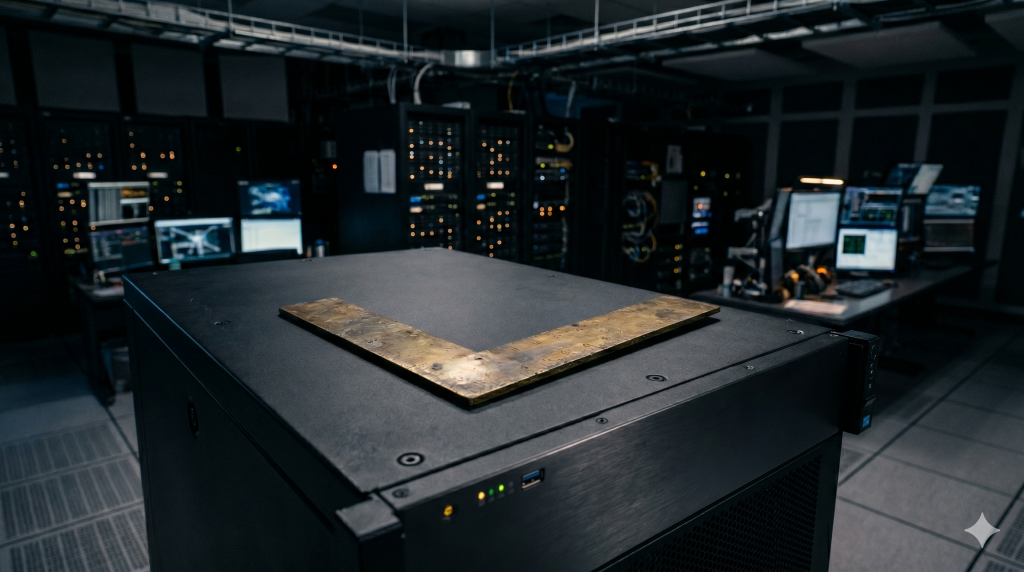
A heavy brass stonemason's square lies atop a modern server rack, blending traditional craftsmanship with modern enterprise infrastructure.
Traditional mid-year reviews fail. They rely on retrospective checklists, memory bias, and linear accounting. Complex systems—software, corporations, or social architectures—degrade when managed through backward-looking audits. Efficiency requires a different approach: the intersection of Site Reliability Engineering (SRE) and Masonic tradition.
SRE principles—specifically declarative state definition, reconciliation loops, and error budgets—shift focus from auditing the past to aligning the present with a defined future. Integrating the Masonic Square of Virtue adds an ethical checksum. The Square demands that every action aligns with fairness, justice, and reciprocity.
This report provides an actionable template for the Mid-Year Checksum. It verifies that your observed state matches your desired state while ensuring your methods remain morally sound.
The Architecture of Intent: Declarative vs. Imperative
Robust frameworks require you to abandon imperative management. In computer science, imperative programming dictates every step to reach an outcome. Declarative programming defines the end state and lets the underlying controller determine the path.
The Benefits of Declarative Management
- Eliminates Fragility: When environments shift, imperative instructions become obsolete. Declarative systems adjust automatically.
- Scales Authority: Leadership acts as the orchestrator, defining the desired business state—revenue, stability, or culture.
- Level-Triggered Logic: Teams act as autonomous controllers. They constantly ask if reality matches intent, rather than waiting for quarterly deadlines.
| Architectural Aspect | Imperative Goal Management | Declarative Goal Management (SRE Paradigm) |
| Primary Definition | Prescribes specific steps, tasks, and methodologies. | Defines the exact desired end-state and boundary conditions. |
| Response to Friction | Requires manual rewriting of the strategy and new instructions. | Autonomous teams adjust tactics continuously to close the state delta. |
| Nature of the Review | A retrospective audit of completed tasks and adherence to plans. | A point-in-time calculation of the delta between actual and desired state. |
| Handling of Failure | Focuses on repairing the broken process or punishing the deviation. | Replaces the failing component; failure is expected and automatically reconciled. |
| Source of Truth | Subjective status reports and fragmented management documents. | A centralized, version-controlled declaration of intent (The Trestle Board). |
In the context of the mid-year checksum, the declarative model demands absolute clarity regarding the intended destination. Without a highly specific, mathematically and ethically measurable desired state, the reconciliation loop cannot function, as the controller has no valid baseline against which to compare the current reality.
The Mechanics of the Reconciliation Loop
The Reconciliation Loop powers the declarative model. Controllers observe the actual state, compare it against the desired state, and close the gap. This cycle prevents state drift.
Continuous reconciliation requires accurate telemetry. Leadership must maintain a cache of organizational data without hammering teams with reporting requests. The Mid-Year Checksum bypasses the cache to perform a “live query,” ensuring the ground truth hasn’t been obscured by management filters.
When projects stall or launch partially, imperative systems treat it as a crisis. A reconciliation system treats it as standard intermediate state. The team calculates the new delta and keeps moving toward the goal.
The Integrity Checksum
A checksum guarantees data integrity. If even one byte changes during transit, the checksum changes, and the system rejects the data. Organizational integrity works the same way. The pursuit of goals must not corrupt the foundational culture. Ethical Debt—rushing results without moral safeguards—accrues interest that eventually destroys trust and reputation.
The Square of Virtue as the Objective Baseline
Operative masons used the square to ensure stones fit with structural precision. Speculative masonry uses it to “square our actions”—applying a universal standard of fairness. This eliminates subjective bias.
| The Three Great Lights | Operative Function | SRE / Organizational Function |
| Volume of Sacred Law (VSL) | The architectural plans and divine inspiration. | The organizational charter, constitution, and ultimate source of truth. |
| The Square | Testing a stone for a perfect 90-degree angle. | The ethical checksum; verifying that actions align perfectly with core values. |
| The Compasses | Drawing boundaries and circles. | System constraints, error budgets, and preventing burnout through boundary enforcement. |
Geometric Proof of Morality
The Square relies on the 47th Problem of Euclid (Pythagorean Theorem). While a cubit is subjective, a 90-degree angle is a universal constant. If you treat ethics as malleable, your organizational structure will collapse under the weight of hypocrisy.
The Ashlar: Continuous Refinement
The Rough Ashlar is the raw, imperfect state. The Perfect Ashlar is the stone shaped and smoothed for the building. The Mid-Year Checksum treats missed targets and conflicts as the rough edges of the stone. The reconciliation loop is the mallet and chisel, guided by the Square, driving the organization closer to the desired state.
Error Budgets and Feature Freezes
An Error Budget quantifies the amount of unreliability a system can tolerate. If the budget hits zero, you implement a Feature Freeze. All new development stops. The team pivots entirely to paying down debt—technical or ethical.
| Error Budget Remaining | Operational Zone | Required Organizational Action (The Policy) |
| > 50% | Green (Normal Operations) | Continue innovation. Pursue new strategic initiatives. The actual state is successfully converging with the desired state without ethical compromise. |
| 25% – 50% | Yellow (Caution Mode) | Increase focus on reliability and ethics. Require higher-level approvals for risky strategic moves. Begin investigating root causes of systemic friction. |
| < 25% | Red (Feature Freeze) | Halt all new initiatives. Redirect organizational energy exclusively toward paying down technical and ethical debt. Re-establish the 90-degree true angle. |
| Exhausted (0%) | Critical (Incident Review) | Absolute freeze on forward movement. Mandatory post-mortem analyses. Re-evaluation of the leadership parameters that allowed the baseline integrity to fail. |
By pre-committing to these actions through a formalized error budget policy, the organization prevents the normalization of deviance. The Square of Virtue is not merely a philosophical abstraction; it is enforced through the rigid, mathematical discipline of the error budget.
The Mid-Year Checksum Template
Follow these four phases to execute the checksum.
Phase 1: Validation (The Trestle Board)
- Re-declare Intent: Document strictly declarative goals. Define what the system looks like, not how to build it.
- Set Boundaries: Use the Compasses to define resource limits and Error Budgets.
- Affirm the Square: Document non-negotiable ethical frameworks and reciprocity standards.
Phase 2: Observation (The Rough Ashlar)
- Gather Telemetry: Collect revenue trajectories, deployment velocity, and employee sentiment.
- Live Query: Bypass management filters. Observe the unfiltered state of teams on the ground.
Phase 3: The Checksum (Verifying Integrity)
- Calculate Delta: Identify drift between actual and desired states.
- Audit for Debt: Search for hidden technical or ethical liabilities (e.g., biased algorithms).
- Validate Signatures: If metrics are “green” but achieved through unethical means, reject the data as corrupted.
Phase 4: Reconciliation (Shaping the Stone)
- Enforce Policy: If the budget is depleted, trigger the Feature Freeze immediately.
- Remediate: Redirect all energy to refactoring code and revising biased policies.
- Commit to the Loop: Treat the checksum as a milestone in an infinite cycle, not a one-time event.
Summary
The Mid-Year Checksum replaces subjective audits with mathematical and ethical discipline. It ensures you build the right structure and that every individual stone meets the unwavering standard of truth.
Works cited
- From Process Management to State Reconciliation – DEV Community, https://dev.to/sreekanth_kuruba_91721e5d/from-process-management-to-state-reconciliation-9cj
- What is Kubernetes orchestration? – Dash0, https://www.dash0.com/faq/Kubernetes-orchestration
- https://www.srsfw.org/what-is-the-scottish-rite#:~:text=The%20square%20reminds%20Masons%20to,and%20their%20passions%20in%20control.
- https://onlinemasonicregalia.co.uk/blog/the-relevance-of-the-square-and-compasses-symbol#:~:text=Square%20%2D%20symbolizes%20virtue.,of%20virtue%20with%20all%20mankind.%E2%80%9D&text=Compasses%20%2D%20represents%20wisdom.,our%20passions%20within%20due%20bounds.%E2%80%9D
- The Three Great Lights | Masonic Articles – Universal Co-Masonry, https://www.universalfreemasonry.org/en/article/the-three-great-lights
- Declarative vs Imperative Programming | [Data Engineers Guide] – DataOps.live, https://www.dataops.live/blog/the-data-engineers-guide-to-declarative-vs-imperative-for-data
- Declarative Vs. Imperative Programming: 4 Key Differences | Octopus Deploy, https://octopus.com/devops/infrastructure-as-code/declarative-vs-imperative-programming/
- Declarative vs Imperative Database Migrations – SchemaSmith, https://schemasmith.com/compare/declarative-vs-imperative-migrations.html
- GitOps vs. DevOps: how can they work together? – Qovery Blog, https://www.qovery.com/blog/gitops-vs-devops-how-can-they-work-together
- Anyone solve the clickops problem or are we all just living with the gap as is? Tried to solve this twice at two different companies, but still not confident we got it right either time. – Reddit, https://www.reddit.com/r/aws/comments/1u3ru16/anyone_solve_the_clickops_problem_or_are_we_all/
- Anvil: Building Kubernetes Controllers That Do Not Break – USENIX, https://www.usenix.org/publications/loginonline/anvil-building-formally-verified-kubernetes-controllers
- Kubernetes Operators: A Deep Dive into the Internals – DEV Community, https://dev.to/piyushjajoo/kubernetes-operators-a-deep-dive-into-the-internals-221m
- What is GitOps? Core Principles and Benefits – Plural.sh, https://www.plural.sh/blog/what-is-gitops/
- What is a Rough Ashlar? — Illinois Freemasonry, https://ilmason.org/our-blog/rough-ashlar-meaning
- ROUGH AND PERFECT ASHLAR (short version) – Squarespace, https://static1.squarespace.com/static/633de83a7a3be671caa006ca/t/64d302610d76b50657b16cab/1691550305158/NVGL_short_lecture003_the+Ashlars_Rough-Perfect.pdf
- Understanding and Implementing the Reconciliation Loop Pattern – OneUptime, https://oneuptime.com/blog/post/2026-02-09-operator-reconciliation-loop/view
- Why Is AI Coding Still Unstable? Loop Engineering May Be the Next Step, https://knightli.com/en/2026/06/16/loop-engineering-ai-coding-kubernetes-control-loop/
- What Is a Checksum? Meaning, Examples & Why You Should Use Them – Linux Security, https://linuxsecurity.com/features/what-are-checksums-why-should-you-be-using-them
- Data integrity verification: Trustworthy 2025 – Alliance InfoSystems, https://www.ainfosys.com/tutorials/data-integrity-verification/
- Linux Integrity Verification: SHA256 and GPG Checks Explained – Linux Security, https://linuxsecurity.com/news/server-security/checksums-in-linux-integrity-guide
- How To Use Data Integrity Testing to Keep Data Clean and Reliable – Heap.io, https://www.heap.io/blog/data-silos-part-4-data-integrity
- The Origins of the Square and Compasses | Scottish Rite, NMJ, https://scottishritenmj.org/blog/the-origins-of-the-square-and-compasses
- The Relevance of the Square and Compasses Symbol – Online Masonic Regalia, https://onlinemasonicregalia.co.uk/blog/the-relevance-of-the-square-and-compasses-symbol
- The Meaning Behind 15 Common Masonic Symbols – George H Lilley, https://www.ghlilley.com.au/blogs/news/freemason-symbols
- About – Ephrata Lodge No. 665, https://ephratalodge665.org/about/
- Rough and Perfect Ashlar – Bricks Masons, https://bricksmasons.com/blogs/masonic-education/rough-and-perfect-ashlar
- The Three Great Lights of Freemasonry | PDF – Scribd, https://www.scribd.com/document/357693667/The-Three-Great-Lights
- The Symbolism of The Square And Compasses You were introduced to the square and compasses very early in your Masonic career, in – Linford Lodge of Research, https://linfordresearch.info/fordownload/Other%20Documents/13%20Five%20Minute%20Talks.pdf
- Masonic Symbolism – Science Abbey, https://www.scienceabbey.com/2025/06/03/masonic-symbolism/
- The Three Great Lights of Freemasonry – Beacon #190, https://beacon190.ca/freemasonry/the-three-great-lights-of-freemasonry/
- Masonic Mathematics: The 47th Problem of Euclid, https://www.srmml.org/masonic-mathematics-the-47th-problem-of-euclid/
- The 47th Problem OF Euclid – Bricks Masons, https://bricksmasons.com/blogs/masonic-education/the-47th-problem-of-euclid
- The 47th Problem Of Euclid – The Square Magazine, https://www.thesquaremagazine.com/mag/article/202104the-47th-problem-of-euclid/
- The 47th Problem of Euclid – MasterMason.com, http://www.mastermason.com/22ndDist/Information/The%2047th%20Problem%20of%20Euclid.htm
- What is your BEST explanation of the 47th Problem of Euclid? : r/freemasonry – Reddit, https://www.reddit.com/r/freemasonry/comments/3orike/what_is_your_best_explanation_of_the_47th_problem/
- Eyes, skulls and compasses: Freemasonry symbolism – Art UK, https://artuk.org/discover/stories/eyes-skulls-and-compasses-freemasonry-symbolism
- The Official ImageGen, 4o and Dall-E Megathread – #1698 by windysoliloquy – Community, https://community.openai.com/t/the-official-imagegen-4o-and-dall-e-megathread/1230134/1698
- The Official ImageGen, 4o and Dall-E Megathread – OpenAI Developer Community, https://community.openai.com/t/the-official-imagegen-4o-and-dall-e-megathread/1230134?page=82
- The Meaning of “Rough Ashlar” | Scottish Rite, NMJ – Northern Masonic Jurisdiction, https://scottishritenmj.org/blog/meaning-rough-ashlar
- The Rough and Perfect Ashlars | Masonic Articles – Universal Co-Masonry, https://www.universalfreemasonry.org/en/article/the-rough-and-perfect-ashlars
- Ethical Debt in AI: The National Security Risk No One Is Measuring | by Mahima Agarwal, https://medium.com/@mahima.agarwal14/ethical-debt-in-ai-the-national-security-risk-no-one-is-measuring-36aa89e8db6c
- Paying Down Your Technical Debt – Coding Horror, https://blog.codinghorror.com/paying-down-your-technical-debt/
- AI technical debt: Impact on compliance – ITLawCo, https://itlawco.com/ai-technical-debt-impact-on-compliance/
- Error Budget in SRE: The Complete Guide (2026) – IsDown.app, https://isdown.app/blog/error-budget-sre
- Understanding Error Budgets And Their Importance In SRE – Netdata, https://www.netdata.cloud/academy/error-budget/
- How to Implement SRE Error Budgets for Service Reliability – OneUptime, https://oneuptime.com/blog/post/2026-02-20-sre-error-budgets/view
- SRE Guide to SLOs, SLIs, and Error Budgets: A Production Playbook | BackendBytes, https://backendbytes.com/articles/sre-slos-slis-error-budgets/
- SLO Framework: A Best Practices Guide, https://www.nobl9.com/resources/slo-framework
- What Is Improper Artifact Integrity Validation? – Palo Alto Networks, https://www.paloaltonetworks.com/cyberpedia/improper-artifact-integrity-validation-cicd-sec9